
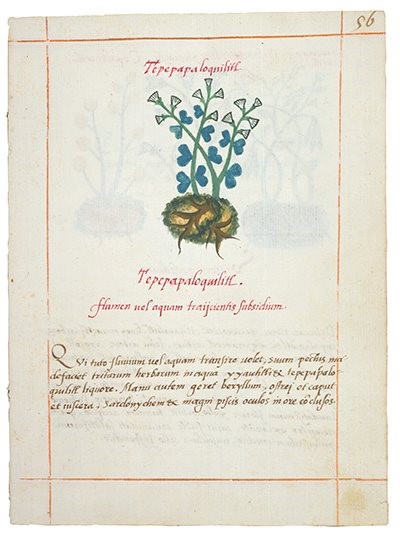
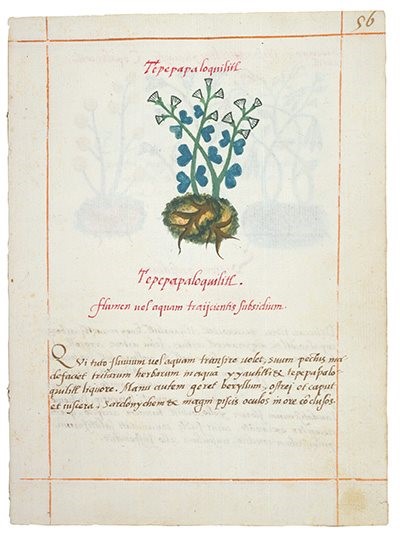
Also called : tepalcachu, pápalo, pipizca de venado.
Tepepapaloquilitl (tepetl – mountain, hill : papalotl – butterfly : quilitl – weed), it is so named because it is a herb which attracts butterflies and it grows on hilly ground or in the mountains.
Porophyllum gracile has also been identified as tepepapaloquilitl.
In the mountains outside Toluca there is a root called “chautl” which comes from a plant identified by locals as papalo. This may be the same plant as tepepapaloquilitl.(1)
The Aztecs used the root of tepepapaloquilitl as a vegetable. The root of the chautl is also used as a vegetable and is a “bit like a potato”.(Carmichael 1995)
- Robert Bye identifies tepepapaloquilitl as Porophyllum punctatum. Tagetes lucida (pericon/yauhtli) has been identified as tepepapaloquilitl in some sources (although I myself think this to be an erroneous identification)

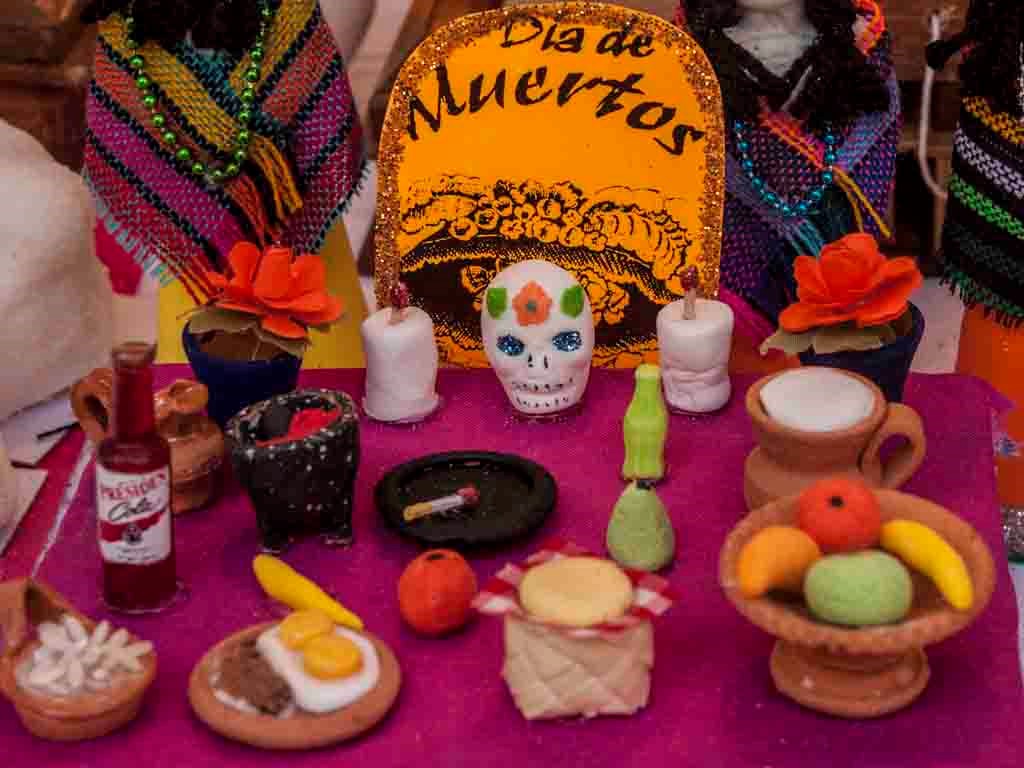
Chautl is used to prepare alfeniques for Dia de los muertos. The root is harvested, cleaned, dried, powdered and added to icing sugar and egg whites. This sugar paste is then used to sculpt figures for the Day of the Dead. The sugar figures are completely edible and can be kept for years if stored properly (Carmichael, 1995)
Hernandez in his text Historia Natural de la Nueva España writes of a herb called TEPEXIPAPALOTZIN or “butterfly of the rocks”. He writes….
“Es un arbusto pequeño con hojas de mediano tamaño y figura de corazón, y flores blancas que se deshacen en vilanos. Las hojas machacadas y tomadas con agua, o bien su cocimiento, curan el empacho. Es caliente en tercer grado y un poco húmedo. Nace en las peñas de los campos de Itzocan”
It is a small shrub with medium-sized, heart-shaped leaves, and white flowers that dissolve into papples (1). The crushed leaves taken with water, or cooked, cure empacho. It’s third degree hot and a little humid. It is born in the rocks of the fields of Itzocan (in the State known these days as Puebla)
- “papples” – this term is referring to the pappus or fluffy seed head common to the Porophyllum species. The pappus is the modified calyx, the part of an individual floret, that surrounds the base of the corolla tube in flower. It functions as a wind-dispersal mechanism for the seeds.


References
- Codex de la Cruz-Badiano (Badianus Manuscript) Libellus de Medicinalibus Indorum Herbis (“Little Book of the Medicinal Herbs of the Indians”) (also called the Codex Barberini) Nahuatl original composed in the Colegio de Santa Cruz de Tlatelolco in 1552 by Martín de la Cruz and translated into Latin by Juan Badiano
- Gates, William (Translator) (2000) An Aztec Herbal: The Classic Codex of 1552 : an English translation of the Libellus de Medicinalibus Indorum Herbis, published by the Maya Society (1939). Dover Publications, Mineola, New York : ISBN 9780486411309 / 0486411303
- Hernández, Francisco (1959 – 84) Historia natural de Nueva España. 7 Volumes. Universidad Nacional Autónoma de México, México, D.F. Reprint of the work originally published in 1651 in a folio edition and later (1790) published in Madrid in a 3-volume edition with Latinversions of the botanical names.
 Masa Americana