

Papalo is a herb that falls under the designation of “quelite” (1). Quelites are (usually) wild herbs that are allowed to grow if they spontaneously sprout within the milpa or are collected from the wild. The term quelite is not limited to leafy herbs but also encompasses the flowers (2), roots (3), vines, stems (4) and seeds (5) of various plants (including trees)(6). Some quelites are ephemeral and can only be found at certain times of the year whilst others are so popular they are grown commercially. Papalo (along with Romeritos)(7) is an example of a quelite whose popularity is such that the plant is commercially grown.
- Quelites : Quilitl
- Las Flores Comestibles : Edible Flowers : Colorin
- Acocoxochitl : The Dahlia
- Xocoyoli : The Sour Quelite
- Guaje.
- Yepaquilitl : Another Skunk Weed
- Quelites : Romeritos
The main areas of consumption of papalo are Puebla and the surrounding States, as well as in Mexico City.
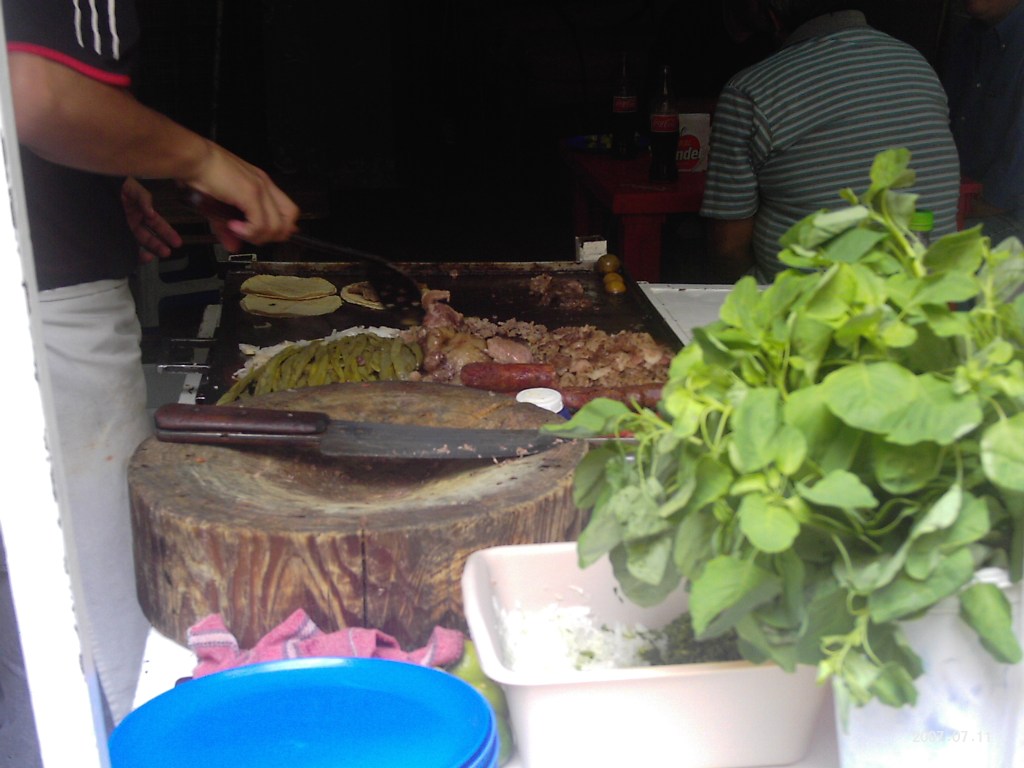
I first came across this herb in its native habitat when I visited México City. As I was informed it would be, I found bouquets of the herb in glasses of water propped up at the taco stand where I could simply break off a sprig and add it to my taco. I had been growing this herb, and it’s cousin quillquina (1) for several years in Australia and it was exciting to finally meet it in its hometown. I also went on to see it growing in botanical gardens and in the chinampas of Xochimilco. Papalo was one of my main reasons for visiting México and I have been studying its culinary and medicinal uses ever since I stumbled upon the word papaloquelite.
Although this quelite was one of the few that was not entirely supplanted by imported herbs and vegetables (1) its use is possibly declining. I’m not sure this will last long though as México seems to be in the midst of a cultural zeitgeist where they are looking to reinvigorate various prehispanic aspects of their culture. The boom in the popularity of pulque is one example of this (2).
- another one that doesn’t seem to have lost any of its popularity is Quelite : Epazote
- Pulque; The Frapulcurado. A Mexican Take on the Frappé; and Pulque as a Cooking Ingredient (just a few examples)
The main areas of consumption of this plant are also the main areas of commercial production.
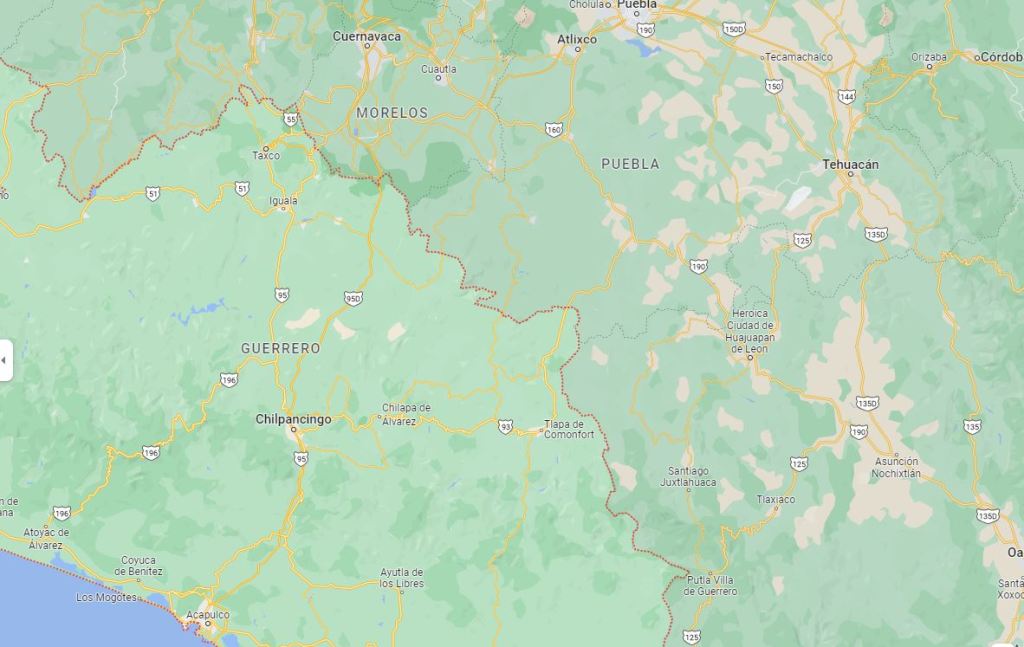
It was noted in a Press release by the Secretaría de Agricultura y Desarrollo Rural (1) on November 13 2021 (2) that figures released by the Servicio de Información Agroalimentaria y Pesquera (SIAP) (3) regarding the production of papalo that in 2020 Guerrero led the way with a total of 4,597 tons of the herb grown in and exported from that region (4). SIAP also noted that on a national level production of this herb grew 21% from 2019 to 2020 with more than 6,800 tons of the quelite being grown with a value of just over 16,000,000 pesos (6).

- Ministry of Agriculture and Rural Development
- https://www.gob.mx/agricultura/prensa/crece-21-por-ciento-produccion-de-papalo-el-tradicional-acompanante-de-los-tacos?idiom=es
- SIAP, from their website “The Agri-Food and Fisheries Information Service, a decentralized body of SAGARPA (5), is in charge of designing and coordinating the operation of the National Information System for the Agri-Food and Fisheries Sector, as well as promoting concurrence and coordination for the implementation of the National Information System for the Sustainable Rural Development” https://nube.siap.gob.mx/cierreagricola/
- followed by Morelos with 1,210 tons and Puebla with 1,080 tons.
- SAGARPA – Secretaria de Agricultura, Ganaderia, Desarrollo Rural, Pesca y Alimentacion – Secretary of Agriculture, Ranching, Rural Development, Fisheries, and Food supply. SAGARPA is responsible for – “developing a policy of support that permits producing, improving, and making the best use of the Agricultural, Livestock, Fisheries, and the Food Supply sector”
- in 2020 a volume of 6,815 tons was reached, with a value of 16,091,000 pesos, while in 2019 production totalled 5,625 tons, for 13,722,000 pesos.
This (the Press release by the Secretaría de Agricultura y Desarrollo Rural) is disputed somewhat by Arturo Garcia Jiménez the President of Red de alternativas sustentables agropecuarias (RASA) (1) who says that SIAP has a tendency to misrepresent figures (and this does seem to be indicated by figures produced by SIAP themselves (2).
- Network of Sustainable Agricultural Alternatives. From their website (https://redrasa.wordpress.com/%c2%bfquienes-somos/) “The Red de Alternativas Sustentables Agropecuarias de Jalisco, is an initiative of civil society, located in the global and national trend towards the construction of alternative experiences of local and sustainable development. It was born as a space in which peasants, indigenous people, women, consumers, urban dwellers, advisers and technicians come together, accompanied by non-governmental organizations and universities. The purpose of the network is the construction of experiences in search of sustainable rural development for the most vulnerable rural inhabitants of Jalisco.”
- https://www.agricultura.gob.mx/datos-abiertos/siap
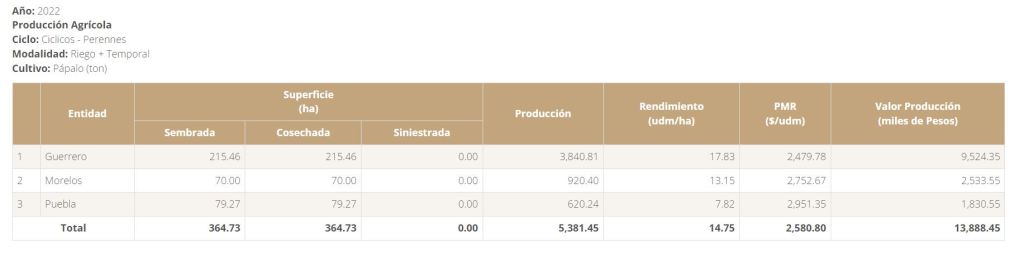
The production and value figures (below) straight from the SIAP website (1) show different figures.

The data below is from 2019 and 2022 (there was no data on papalo from 2020 that I could find)
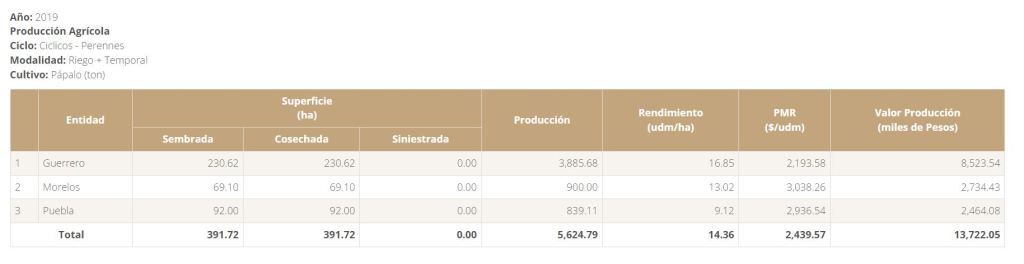
(sembrada = sown : cosechada = harvested : siniestriada = wrecked/damaged)
2019 – total production 5624.79 tons at 13,722.05 (miles de pesos)
2022 – Total production 5,381.45 tons at 13,888.45 (thousands of pesos).
These figures show a decline in production since 2019 (or at least between 2020 and 2022). This may simply be a result of COVID as during this time there were many shut downs and quarantine periods that prevented the consumption of street vendor and restaurant food and this no doubt had an effect on the need for this plant in public spaces.
Guerrero still leads the way in production though by a factor of 3 or 4 times the production levels of Morelos and Puebla.
Arturo highlights that papalo production is so high in Guerrero as its consumption is part of the culture there and that it has always been responsible for over 50% of its production. Papalo from Guerrero is also exported to el otro lado (the U.S.A.)
75.3% of the papalo produced was via irrigated fields whilst the remaining 24.7% was produced seasonally as part of the “spring-summer production cycle” (1). The spring – summer cycle (or the “rainy season”) is the period of the year when the greatest amount of plant resources can be found. Almost 50% of the wild quelites can only be found during this time (Flores-Sánchez etal 2022). Papalo does not fall into this category though. It is grown widely in home gardens and can be found in areas that have a constant water supply (i.e. near streams and rivers). Much of its agricultural production is supported by irrigation.
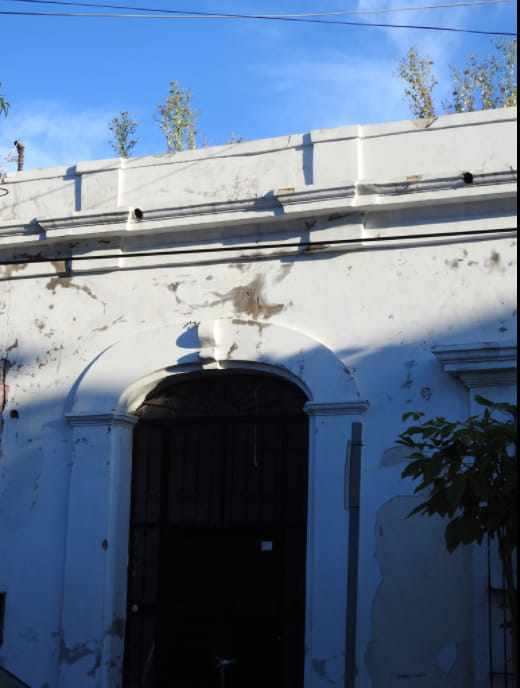
Papalo can be an effective weed plant though. Here it can be seen growing on a rooftop.
It is also pointed out that due to papalos high calcium, potassium and phosphorus content that this quelite is an excellent option for people with nutritional deficiencies of these elements. Medicinally it is also said to be good for the whole digestive system from treating bad breath to being a potent anti-inflammatory of the G.I.T. (1) and being valuable in the treatment of griping caused by intestinal gas. All of the porophyllums I have studied and written about have some medicinal utility. I go into it in greater detail in the individual Posts on these plants.
- Gastro Intestinal Tract (the hollow tube that traverses our bodies from mouth to anus) and which is responsible for a large amount of health issues if it is not operating effectively.
Although consumption of this quelite is a very old practice (1) and these days its most common use is as an accompaniment to tacos (2) its use is declining.
- https://oncenoticias.digital/economia/produccion-de-papalo-en-mexico-crecio-21-en-2020-lo-consumes/31687/
- particularly al pastor, suadero, bistec, longaniza or carnitas – and the Pueblan sandwich known as a Cemita
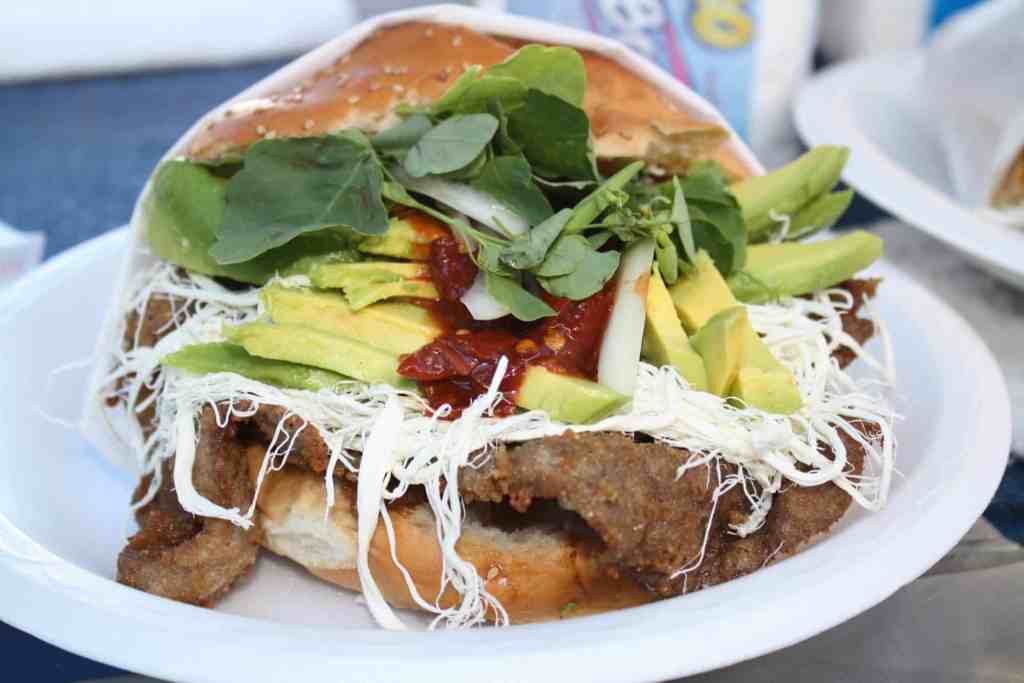
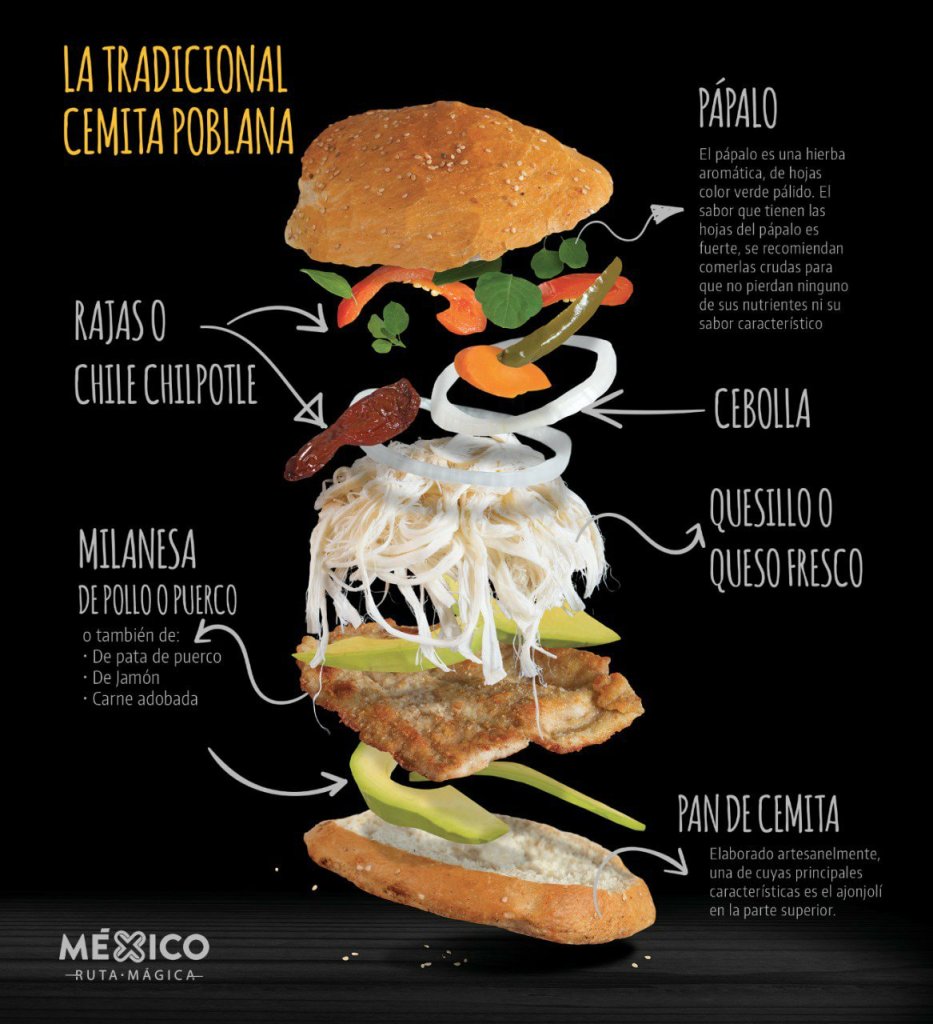

The name of this “sandwich” – cemita – is derived from semite (or semetic) which is an obsolete term for a member of any of the peoples who speak or spoke a Semitic language, including in particular the Jews and Arabs and it refers to the bread roll used to make the sandwich. This sesame seed crusted bread roll has evolved from unleavened bread, of Jewish origin, which was utilised by the Spanish in their long sea voyages to and from the Americas.
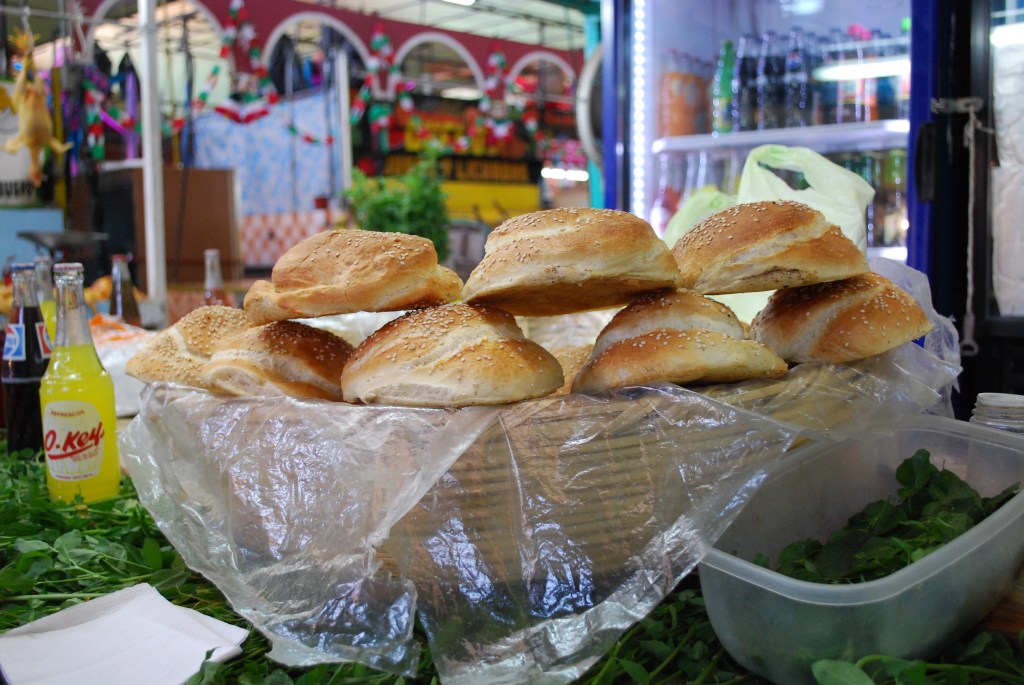
Cemita rolls at a mercado in Puebla
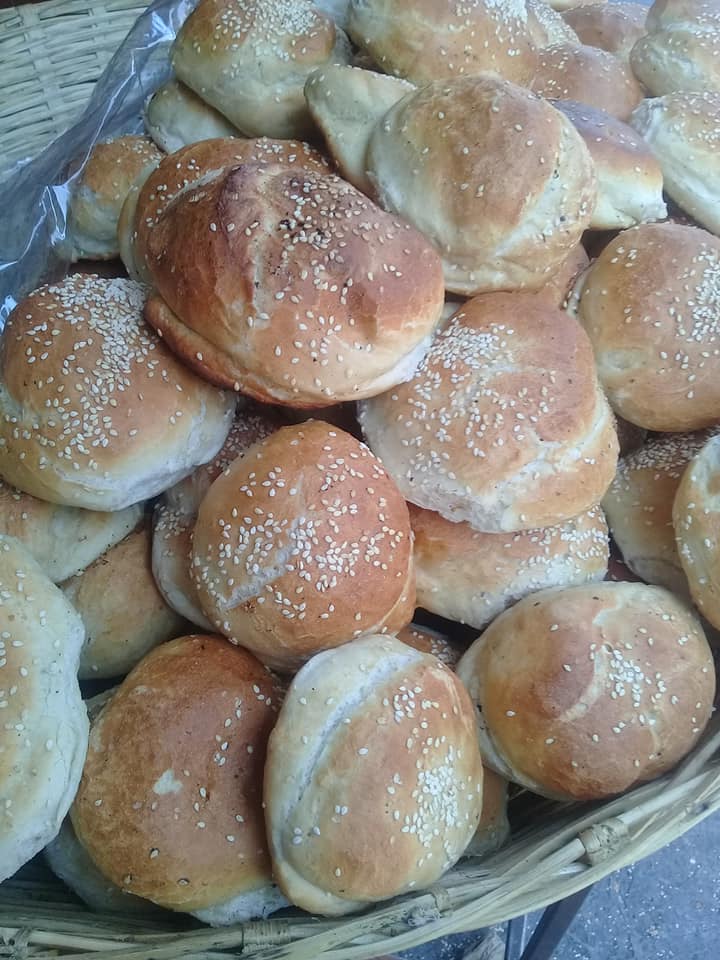
Cemitas at a panderia in Atlixco, Puebla
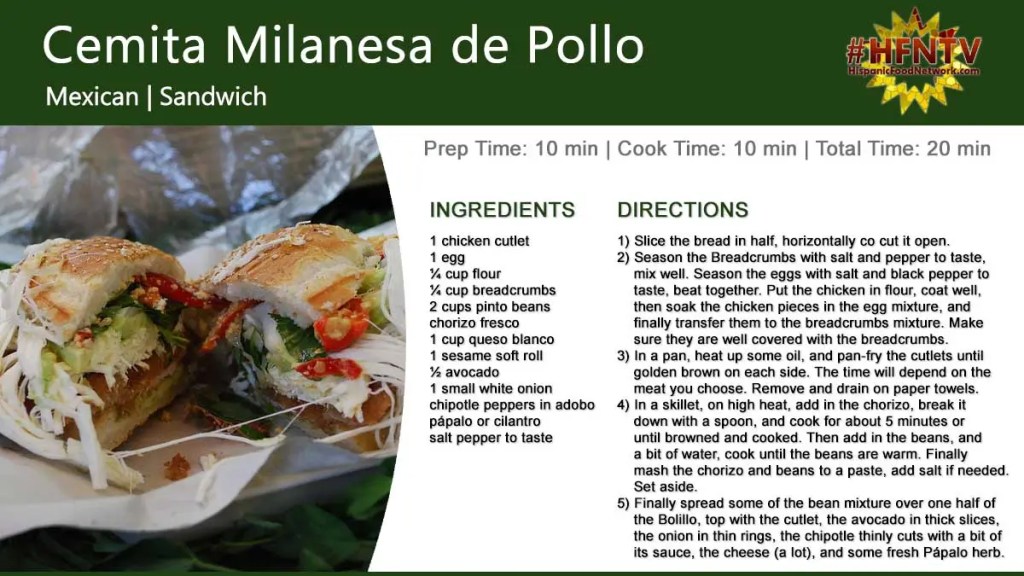
The Cemita, like the Torta, can be filled with a multitude of ingredients (although you are less likely to find some of the more esoteric Torta fillings in a Cemita) (1).
- Papalo at the Taqueria – this Post describes some of what ends up in a torta. The torta will receive its own Post in the future.

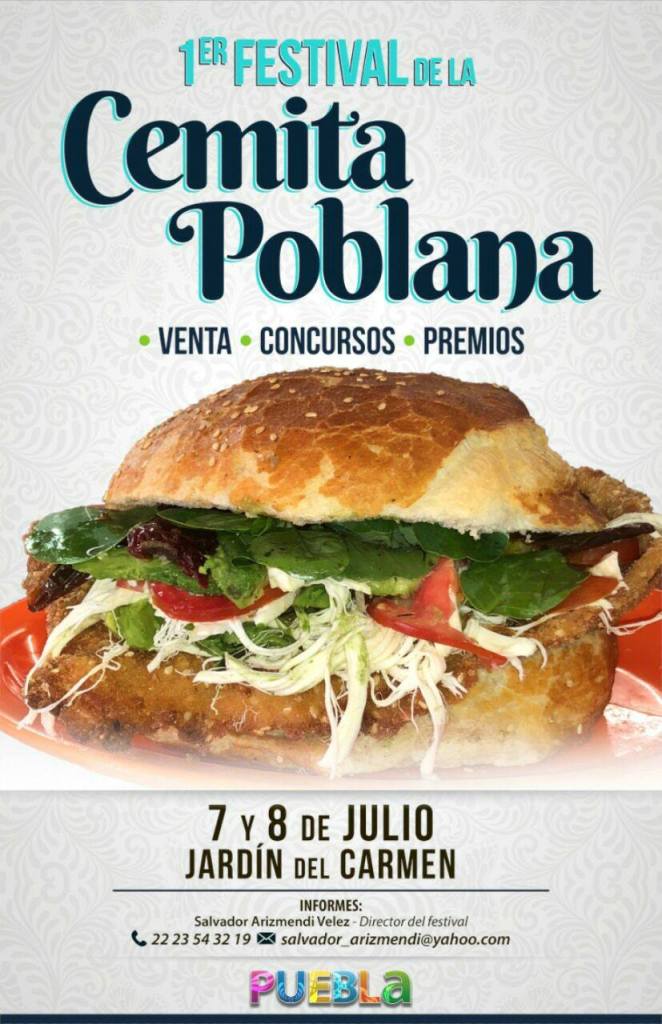

The Cemita, like the Torta, is celebrated annually with its own fiestas.

Before we can make the Cemita we must first make the cemita. Check my Post Papalo at the Taqueria for a link to a recipe for making cemita bread rolls. This roll is very similar to an Australian hamburger roll.
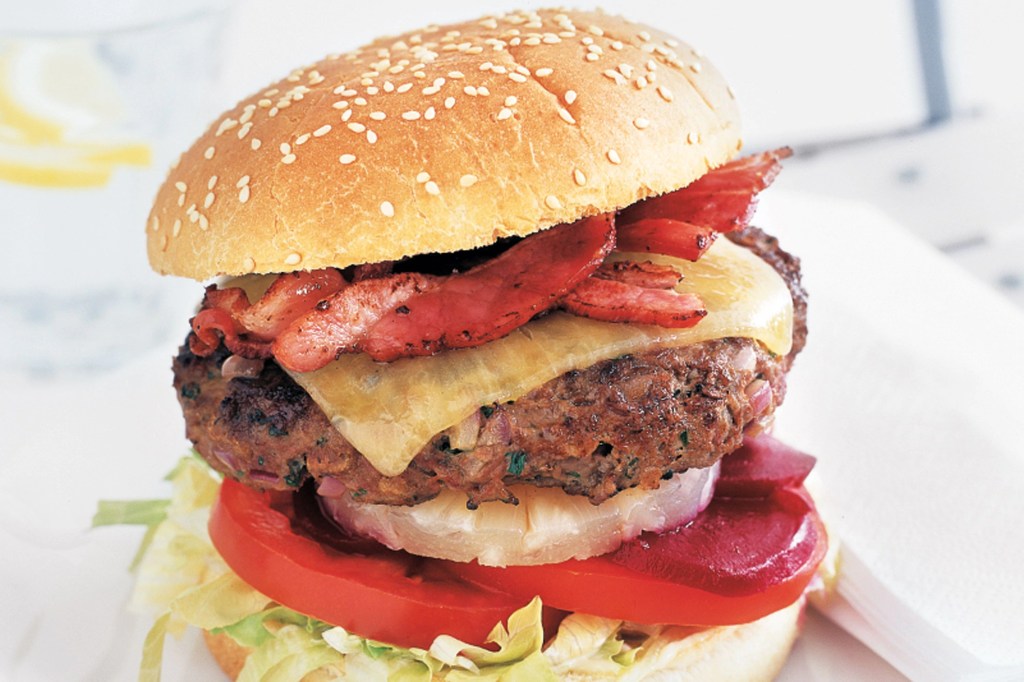
I do find though that the cemita is a sturdier roll than the softer Aussie hamburger bun.
(for a laugh) https://www.buzzfeed.com/jemimaskelley/beet-root-heh-heh-heh
References
- Flores-Sánchez D, Hernández-Ruíz A, Navarro-Garza H, Vázquez-García V, Vibrans H. 2022. Wild plants in the diet of peasant families in Tecoanapa, Guerrero. Agricultura, Sociedad y Desarrollo https://doi.org/10.22231/asyd.v19i2.1289
- (RASA) Gerritsen, Peter R.W.. (2011). ‘Creating (Local) Space for Change’: Strengthening Agroecological Farming and Fair Trade Practices in the State of Jalisco, Western Mexico. International Review of Social Research. 1. 10.1515/irsr-2011-0022.
Websites
- https://www.agricultura.gob.mx/datos-abiertos/siap
- http://www.eluniversal.com.mx/english/street-vendors-are-embedded-mexico-citys-culture-and-history
- https://foodtank.com/news/2020/03/how-will-coronavirus-affect-our-food-a-dispatch-from-mexico/
- https://www.gob.mx/agricultura/prensa/crece-21-por-ciento-produccion-de-papalo-el-tradicional-acompanante-de-los-tacos?idiom=es
- Cemita milanesa de pollo : https://hispanicfoodnetwork.com/cemita-milanesa-de-pollo-chicken-sandwich/
- http://nau.maps.arcgis.com/home/webmap/viewer.html?webmap=eb59739aba984916803b0e87a6d78abc
- http://www.npr.org/2020/04/06/828303859/for-mexican-street-vendors-coronavirus-means-a-huge-loss-of-income
- https://nube.siap.gob.mx/cierreagricola/
- https://oncenoticias.digital/economia/produccion-de-papalo-en-mexico-crecio-21-en-2020-lo-consumes/31687/
- https://redrasa.wordpress.com/%c2%bfquienes-somos/
- http://www.sandiegouniontribune.com/business/nation/story/2020-07-04/street-vendors-protest-coronavirus-lock-down-in-mexico-city
- https://storymaps.arcgis.com/stories/ac31576a3d364c44a941eeed37a6b571
- https://suracapulco.mx/impreso/5/guerrero-primer-lugar-nacional-de-papaloquelite-segun-la-sader-productores-ven-inflados-los-datos/
Images
- Al pastor – By William Neuheisel – Flickr: Tacos al Pastor, CC BY 2.0, https://commons.wikimedia.org/w/index.php?curid=32052588
- Suadero – By Pedro Sanchez – Own work, CC BY-SA 3.0, https://commons.wikimedia.org/w/index.php?curid=1571820
- Bistec – ProtoplasmaKid, CC BY 4.0 https://creativecommons.org/licenses/by/4.0, via Wikimedia Commons
- Longaniza – https://pinaenlacocina.com/tacos-de-longaniza-pork-sausage-tacos/
- Carnitas – https://recipes.fandom.com/wiki/Carnitas_Tacos
- Cemitas Image 1 . Cemita rolls at a mercado in Puebla – By AlejandroLinaresGarcia – Own work, CC BY-SA 4.0, https://commons.wikimedia.org/w/index.php?curid=11713613
- Cemitas Image 2. Cemitas at a panaderia in Atlixo, Puebla via Pan para cemitas”GUZMÁN” on Facebook
 Masa Americana