

Luis Ricardo Amendolla Gasparo, (1928-2000)
or (1939-2000, see Mexican Artist : Amendolla for a little more on this)
As a newbie art researcher I have been excited by my latest mystery. A few weeks ago I came across some Mexican (?) artefacts on Facebook Marketplace. The mother of the woman selling them had recently passed away and she possessed a house full of art pieces collected over a lifetime. This lady had spent her life growing up in Japan, Korea, Indonesia, Portugal and Mexico (travelling due to her mothers work as an artist) and had herself amassed quite a collection. She had little room for her mothers collection. Some of the more significant pieces were donated to a museum and other pieces loved by various family members found their new homes. The rest she hoped would find homes with people who would appreciate the art.
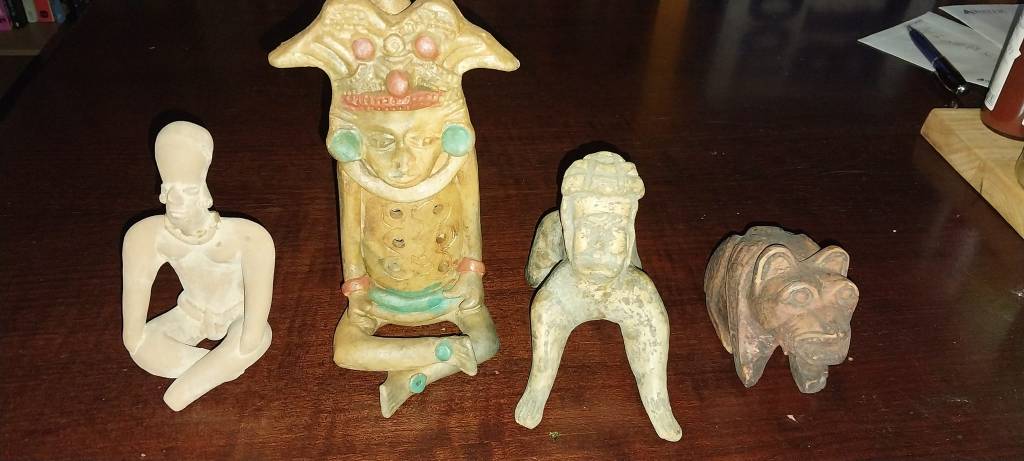
I was absolutely chuffed with what I considered to be quite the score. Now the pieces have some age, having been purchased in the 1960’s but they do appear to be of the 100% genuine fakes that are pedalled to tourists and, aside from the clay “flute” typical of the tourist fare hawked outside of any Mesoamerican archaeological site open to tourists, I have no idea where the items may have originated.

Examples of wind instruments crafted in the shape of a kneeling figure. These are all very similar mine and will likely be found at any souvenir stand in Mexico.
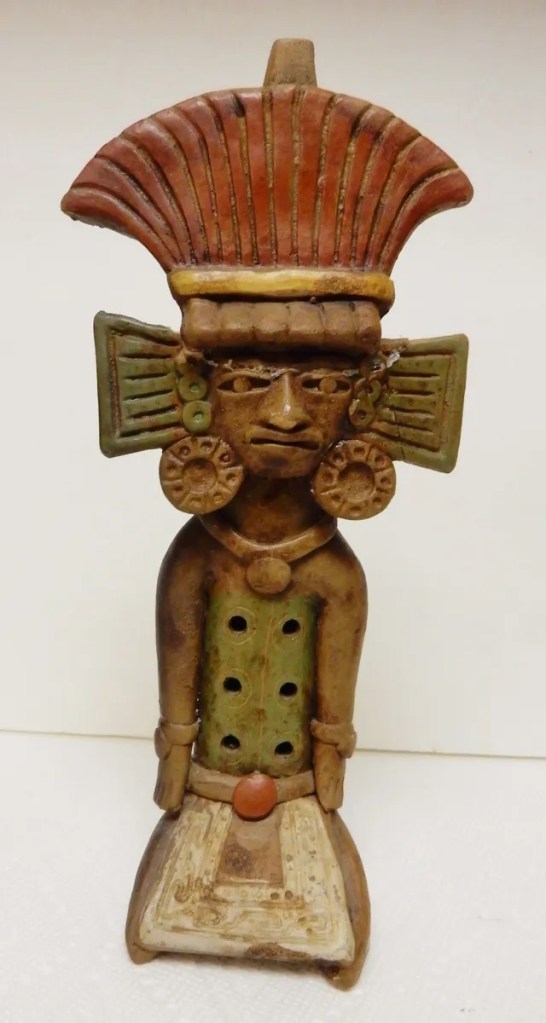
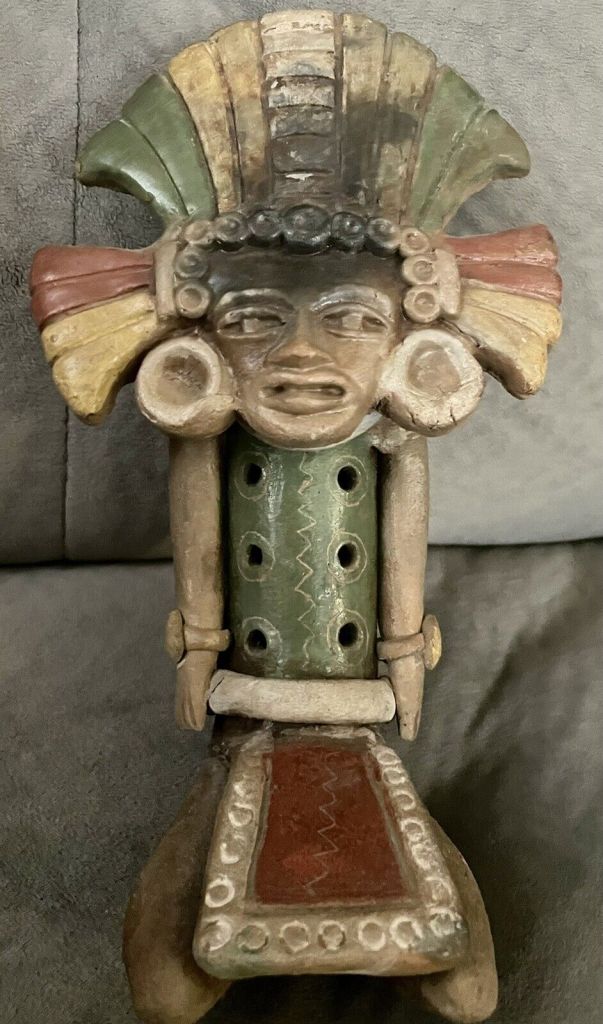
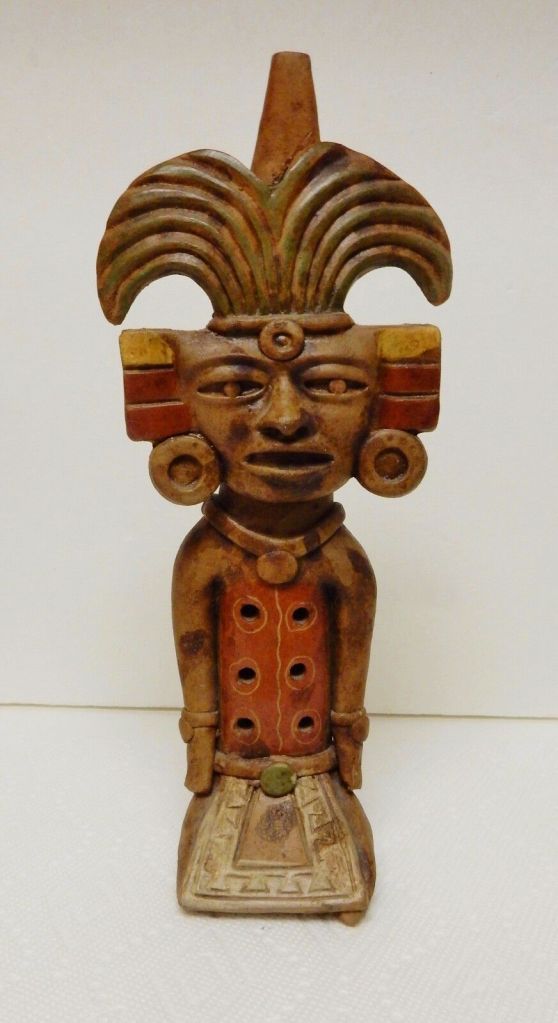
Souvenir stand at Chichen Itza

The next few I have no idea of their provenance. All were purchased in México in the late 1960’s. I would assume they are all tourist fare but I am unable to say what style they are fashioned in and what region or era they may have originated form. The crawling figure seems to show great age where its leg has broken but the material it is made from seems quite modern and in some places on the head/face I swear I can see lines where the head might have been shaped in a mould.
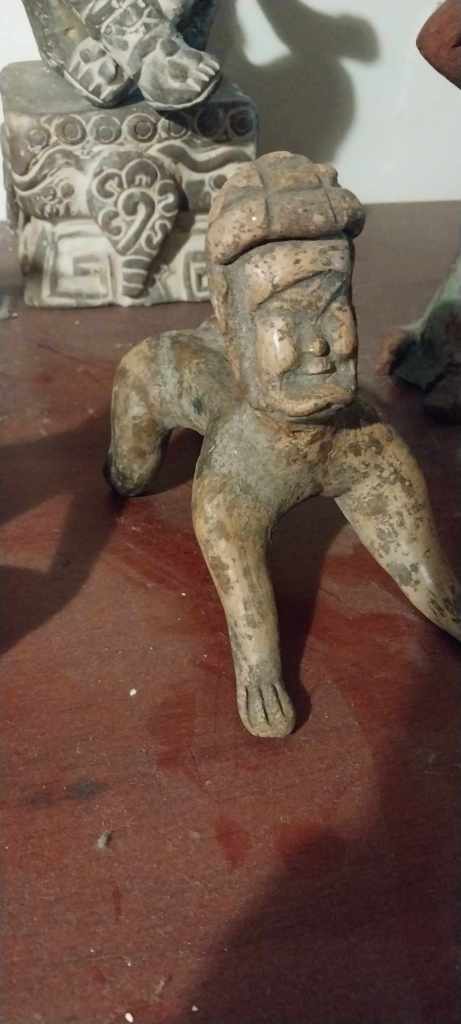
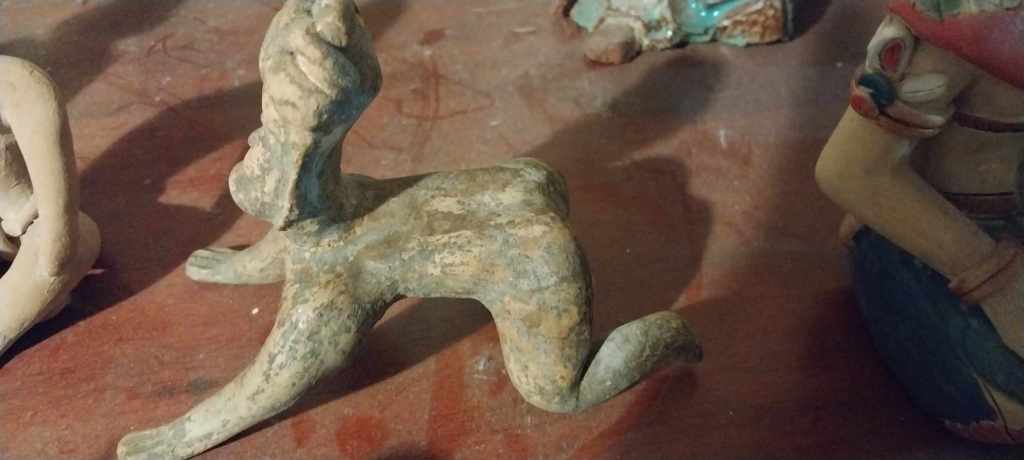

This seated figure with its elongated head appears to be more modern than the image above. The crawling figure has been dirtied and roughened up (much like the figure after this one) to appear more aged. This is a common tactic when trying to peddle “genuine” artefacts to the gullible. I wonder if this woman purchased any of these items thinking they were prehispanic?


The dog/wolf/bear (?) What the heck is this animal? It appears to be less dog/wolf like than it does a bear but it has a long curled tail? It was also said to have been procured in México but to mine untrained eye it doesn’t appear Mexican. Maybe it comes from a group further North? As far as Canada perhaps? It will remain a mystery until I stumble across a pertinent piece of information (or perhaps one of you knows?)


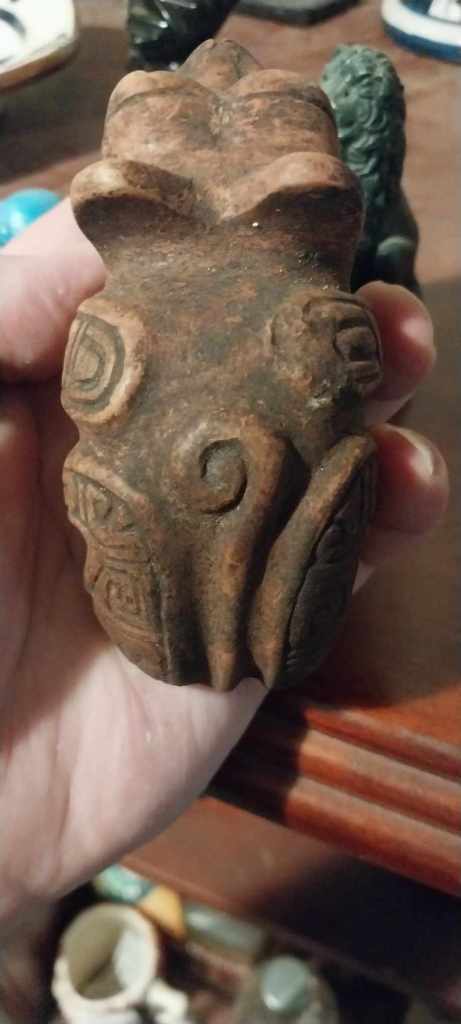
When she saw how pleased I was with the ceramic figures she took me into another room filled with framed paintings propped up on chairs and haphazardly displayed around the room. There were 20 or 30 paintings ranging in media from oils and watercolours and mainly of people or landscapes, nothing abstract.
There was a triptych (Look, I might be neither artist or art historian but some of my friends are seriously arty people – I know words) of what appeared to be a Mexican hacienda style property, but turned out to be a landscape of somewhere in Portugal, that caught my eye but she was taking me to a watercolour of San Bernardino, Xochimilco.

I was immediately drawn to it (I have fond memories of Xochimilco) and I couldn’t pass it up. It now hangs where I can examine it every day and dream dreams of one day returning to Mexico. Sigh.
Art is a balm for the soul and as a naturopathic healer I recommend either participating in creating art or appreciating art so as to be able to wholly address the health of your mind, your soul, and as a consequence, your body. Do not deny the art in you.
One thing the painting did do was pique my interest in Mexican art and artists more modern than Itzcoatl and less well known than Posada, Kahlo and Rivera so down the rabbit hole I went.
I already have a few paintings of Mexican landscapes (although the one on the far right is contentious) fortuitously discovered during my various thrift store explorations . Each piece is beautiful in its own right but none are signed in any significant manner and the artists may forever remain a mystery to me. The latest picture? Not so much. That bad boy was not only signed but signed in such a particular manner that its creator can be in no doubt.

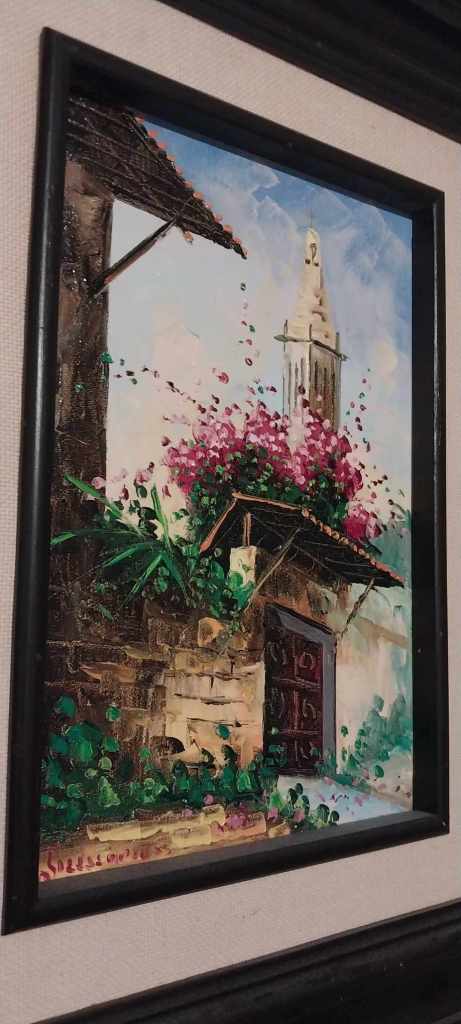
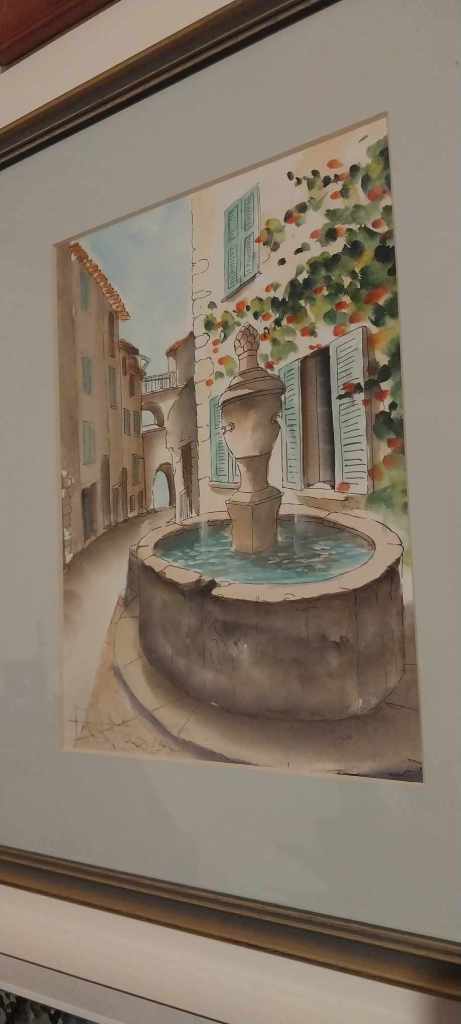
And that creator was Luis Ricardo Amendolla Gasparo. So, off to research I go.
I have Posted on the journey so far here…Arte Mexicano : Mi Colección…….and here……..Mexican Artist : Amendolla….so I won’t go over it again BUT I noted in both Posts that I was unable to find any images of Luis. There’s even a pamphlet of an art display that lists the artists and has images of all of the artists except for Amendolla.

So the search continued.
Then, only yesterday (middle of Jan 2024), I came across this image.
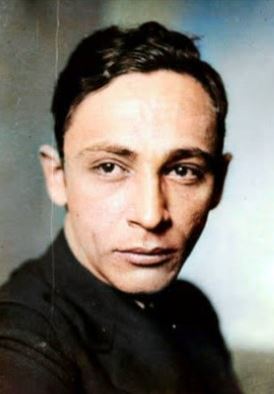
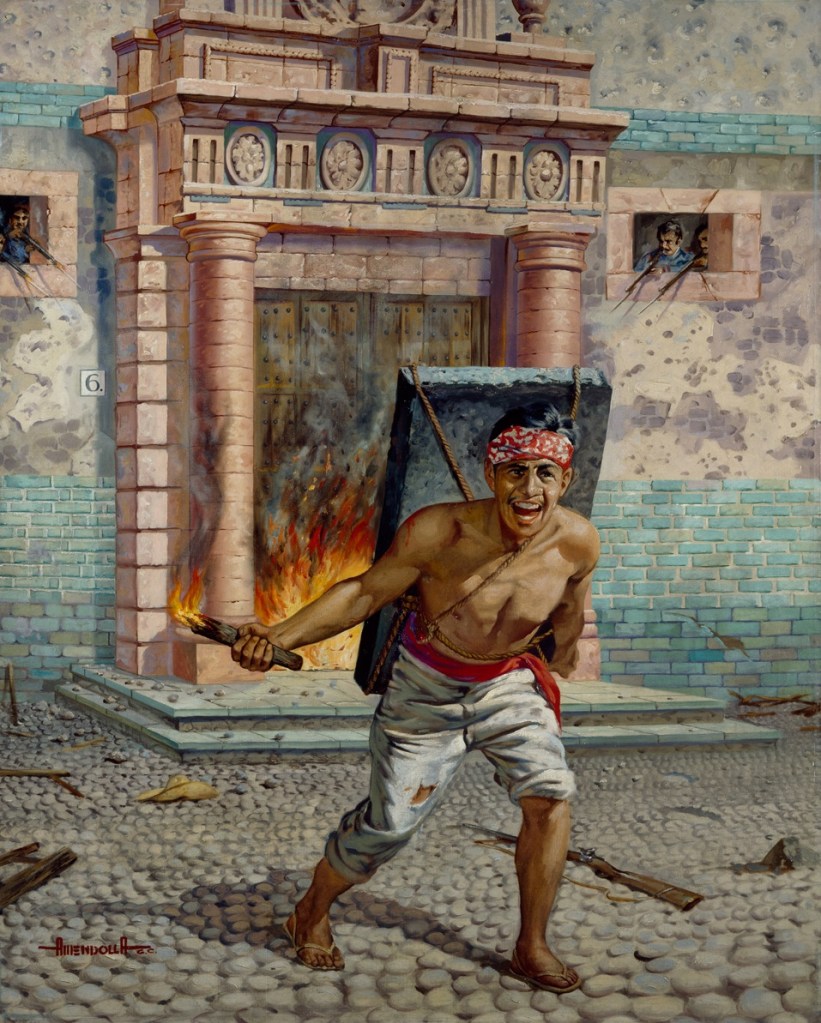
It was part of a X/Twitter post and showed one of Amendollas paintings that currently resides in the Soumaya Museum in Mexico City. A screenshot of the Post is below. It contained no other info. No caption specifically says the image is of Amendolla (at this stage I’m only assuming that it is as I’ve never seen a picture of the man) and no year is given. It is a picture of a youngish man (perhaps in his late 20’s – early 30’s? – I don’t know…I’m not great at this kind of thing….particularly not from a photo likely taken in the 50’s or 60’s?……I’m not even sure if its a colour photo or a black and white one that’s been colourised.)

El Pípila, en la obra del acuarelista
Luis Eduardo Amendolla, cromo creado en 1958.
1928___2000.
El Pípila, in the work of the watercolorist Luis Eduardo Amendolla, card created in 1958.
Now I did consider that the photo might have been of the model for Amendollas work but as el Pípila was said to have been born in 1782 and to have died in 1863 I think this unlikely.
A few months earlier the painting had been posted on X/Twitter by the Soumaya Museum who have it on display in their Galas De México collection. This by itself leads me to believe that the image was created for a calendar. See my previous Posts on Amendolla I mentioned earlier. They go into this in more detail.
@ElMuseoSoumaya (Twitter/X) 12:00 am · 4 Jan 2023
Juan José de los Reyes Martínez Amaro, mejor conocido como “el Pípila”, nació #UnDíaComoHoy de 1782.
En la colección #GalasDeMéxico conservamos algunas imágenes del minero guanajuatense, quien participó en la toma de la Alhóndiga de Granaditas.
• Juan José de los Reyes Martínez Amaro, better known as “el Pípila”, was born #UnDíaComoHoy in 1782.
• In the #GalasDeMéxico collection we preserve some images of the Guanajuato miner, who participated in the taking of the Alhóndiga de Granaditas.
The legend of El Pípila
El Pípila was the nickname of Juan José de los Reyes Martínez Amaro (1) a local hero and legend of the city of Guanajuato in Mexico. El Pípila is a nickname which according to my my Spanish dictionary refers to…
- pípila (Spanish) Noun : pípila (fem.) (pl. pípilas) (Mexico) (female) turkey : Synonym: guajolote, pavo
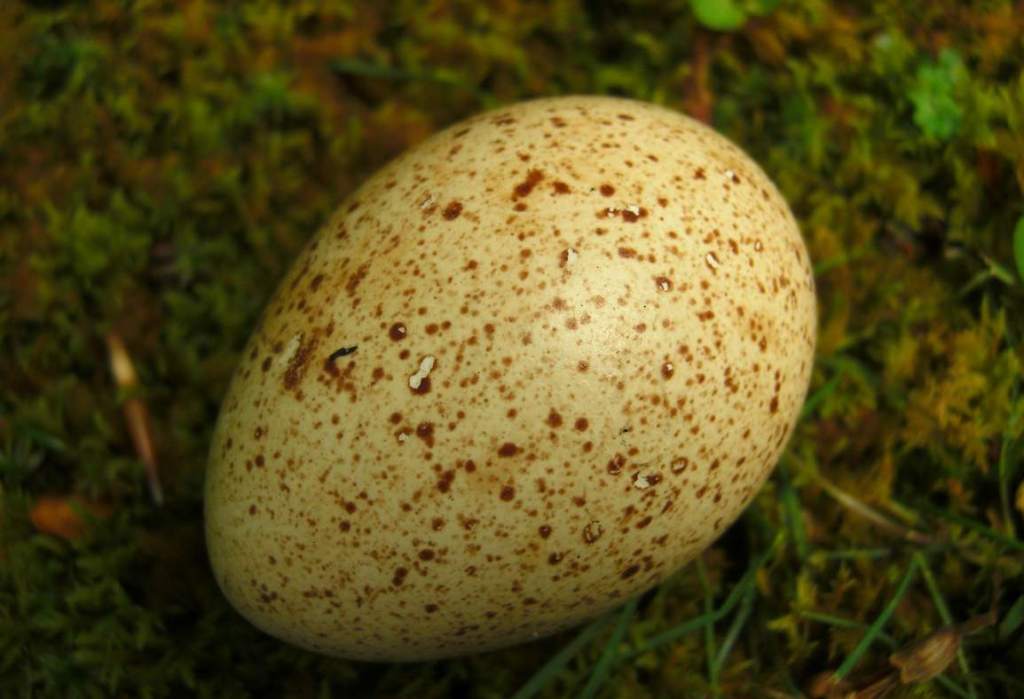
….and is said to reference either his “freckled face (similar to that of a turkey egg) or his laughter resembling the bird’s peculiar gargle”.
El Pípila was a miner. He came from the nearby town of San Miguel (now called San Miguel de Allende) and had relocated to the city of Guanajuato (in the Free and Sovereign State of Guanajuato) where he worked in the Mellado mine and where his act of derring-do would soon occur. (The Mellado mine was one of the first mines in Guanajuato, opened in 1558).
On 28 September 1810 El Pípila became famous for an act of heroism near the very beginning of the Mexican War of Independence. Led by the criollo priest Miguel Hidalgo, the insurrection had begun in the nearby town of Dolores. At some stage during the hostilities the Spanish (in retreat) had barricaded themselves (along with plenty of silver and other riches) in a grain warehouse known as the Alhóndiga de Granaditas. The granary was a stone fortress with high stone walls and a heavy wooden door as its only access. This wooden door would soon be its undoing.

That building certainly looks to have taken a lot of gunfire.
With a long, flat stone tied to his back to protect him from the muskets of the Spanish troops, and with no concern for his own safety, El Pípila carried a bucket of tar and a flaming torch to the door of the Alhóndiga, coated the door with tar and set it on fire. The fire weakened the door and the smoke obscured the sight of the Spanish marksmen which allowed the revolutionaries to break the siege ultimately enabling Hidalgo’s forces to win the first victory of the independence movement. These “insurgents”, who far outnumbered the Spanish in the warehouse, stormed inside and killed all the soldiers and the civil Spanish refugees.
1. (1782–1863), son of Pedro Martínez and María Rufina Amaro.


Lets get back to the man, the artist, the enigma
The portrait of Luis was part of a Mediateca INAH (Instituto Nacional de Antropología e Historia) open-access digital repository of images made available to the public for cultural and historical research. It also included another image of the artist from the same era (sometime in his mid to late 20’s) dressed as a well heeled businessman.
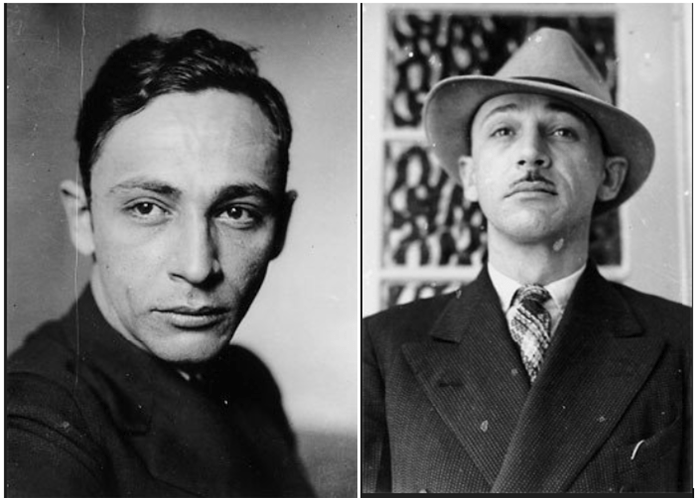
Mediateca, via the Mexican Government I.N.A.H. website, offers some more insight into Luis through archived photographs. Luis (right) speaking with a journalist.

We catch a glimpse of Luis in the book Óleos y acuarelas (Oils and Watercolours) penned by another Mexican artist Edgardo Coghlan. This book is a major retrospective of the paintings and watercolours painted by Edgardo. He (like Amendolla) specialized in watercolours depicting Mexican landscapes and people. His work (again, like Amendolla) became very popular during his lifetime, collected by museums, other institutions and even Mexican presidents. He was a co-founder of the Sociedad Mexicana de Acuarelistas (Mexican Society of Watercolourists) which was created to promote the idea that this medium should be considered equal to other forms of painting.
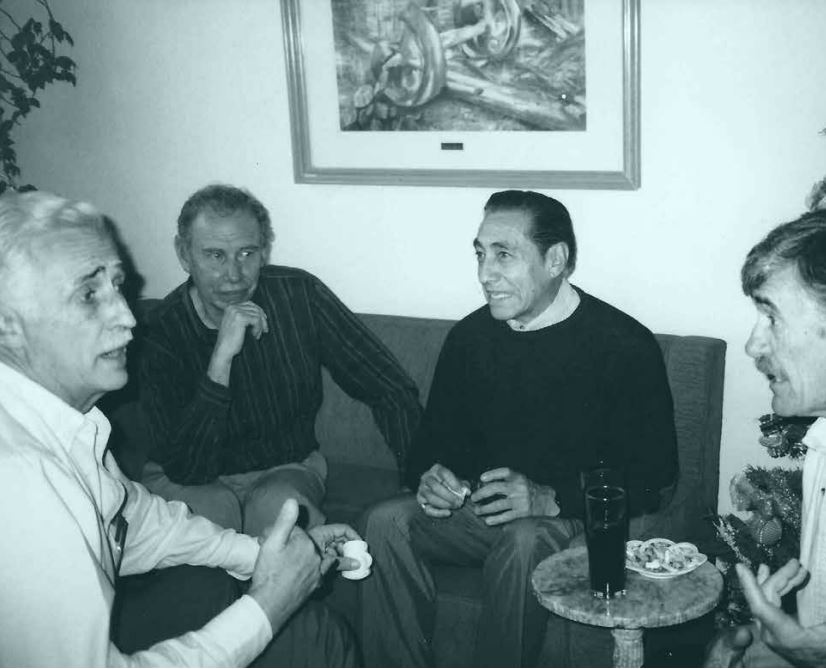
Edgardo Coghlan (1928 – September 28, 1995) born in Los Mochis, Sinaloa in 1928 to Irish and Mexican parents, was a Mexican painter who mostly specialized in watercolours depicting Mexican landscapes and people.
The image above shows Amendolla (3rd from the left) as a much older man. No date is given in the photo but as he died in 2000 at either 61 or 72 (depending on his birthdate…..see the aforementioned Posts) we can put him at the very least in his 60’s and this image shows a man that could definitely be an older version of the first photo. Quite the bohemian group drinking, smoking and talking smack about other artists (no doubt).
Examples of Edgardos work


I can see the similarities between the two mens subject matter and work and can easily imagine the two artists travelling within the same circles.
At some stage Luis taught art classes. I have found reference to his classes in the resumes of other artists. For example….
- Isabel Aburto – Workshops with Teachers: Rodolfo Aguirre tinoco, Gustavo Alanís, Luís Amendola, Manuel Arrieta (and many others)
- Patty Buezo de Valladares – Taller de Acuarela con el maestro mexicano Luis Amendolla (Watercolor Workshop with the Mexican master Luis Amendolla)
Luis supported artists in other ways too.
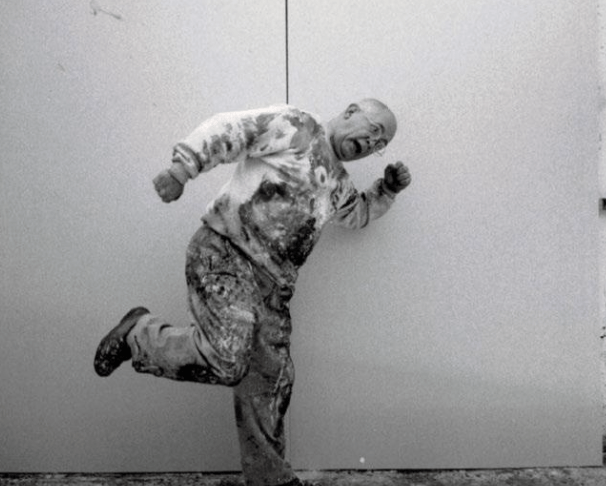
”Por soledad me la pasaba en los cabarets y burdeles de obreros. Sobrevivía vendiendo a 300 pesos los cuadritos que hacía en el parque, haciendo rótulos y pintando calendarios para Casa Galas, adonde me llevó Luis Amendolla, un pintor amigo, emprendedor y aventurero.
“I spent my time in cabarets and workers’ brothels because of loneliness. I survived by selling the little pictures I made in the park for 300 pesos, making signs and painting calendars for Casa Galas, where Luis Amendolla, a painter friend, entrepreneur and adventurer, took me.” Gilberto Aceves Navarro
The only direct quote attributed to Amendolla that I have found (so far)…..
“Me ahondo cada vez más, en la observación de figuras y formas plasmadas en el lienzo, me imagino composiciones varias, texturas diferentes, valores tonales contrastados, distintos tipos de luz y luego de múltiples variaciones imaginarias, pinto, analizo, estudio”.
Luis Amendolla.
I delve deeper and deeper into the observation of figures and forms captured on the canvas, I imagine various compositions, different textures, contrasting tonal values, different types of light and after multiple imaginary variations, I paint, analyze, study.
Fuente consultada: Diccionario biográfico enciclopédico de la pintura mexicana. (Biographical encyclopaedic dictionary of Mexican painting/Encyclopedic biographical dictionary of Mexican painting) México. Quinientos Años Editores, 1979, Pág. 208
I shall continue searching. There is no way I have reached the end of this journey yet.
References
- Coghlan, Edgardo. (2018) óleos y acuarelas “oils and watercolours” : Primera edición: Secretaría de Educación del Gobierno del Estado de México, 2018 (pages 32-33) – https://foem.edomex.gob.mx/sites/foem.edomex.gob.mx/files/catalogo/Edgardo%20Coghlan.pdf
- García, Erik Velásquez. “Mesoamerican Allegories in the Calendar Art of Galas De México, Por Erik Velásquez García, 2014.” Calendarios mexicanos. Mexican Calendars Mexican popular painting with Mesoamerican allegories (2014): 300–307. Print.
- Gilberto Aceves Navarro – https://revista-liber.org/articulo/gilberto-aceves-navarro
- Souvenir stand at Chichen Itza – Wolfgang Sauber, CC BY-SA 3.0 https://creativecommons.org/licenses/by-sa/3.0, via Wikimedia Commons
 Masa Americana