

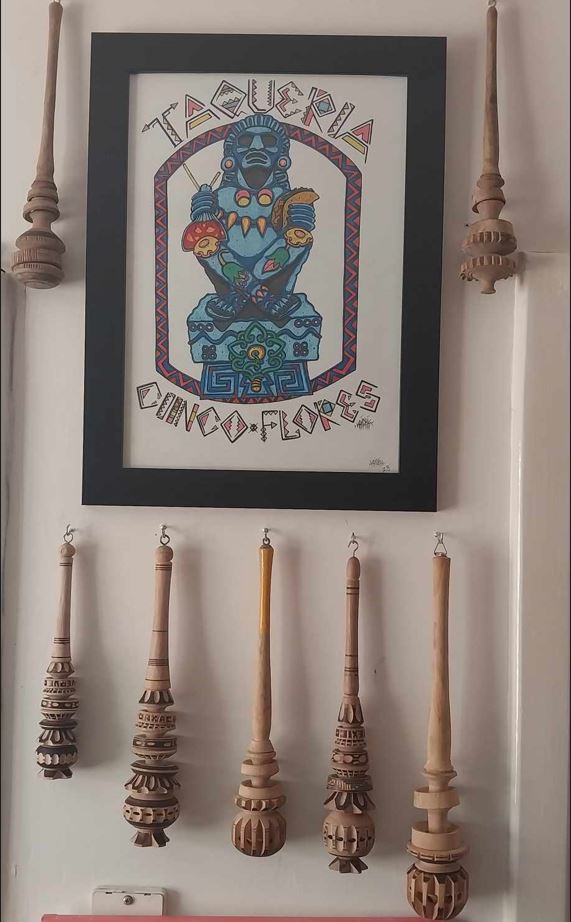
The molinillo is a Mexican kitchen tool that may or may not be prehispanic (1). Regardless of its origin it is a classic Mexican implement and recognisable (in one form or another) by any latino. Its primary purpose is to mix hot chocolate (or atole) and to whisk up a nice foam (not in atole though).
- I go into that in more detail here Mexican Cooking Equipment : The Molinillo and I take a bit of a detour here Gentification of the Molinillo?
I have a small collection of these items. One I picked up in the CDMX whilst on holiday and, much to my surprise, in the years since I’ve been to México I have found another three in thrift stores (in Western Australia) and even had one gifted to me by a friend who also found one in a 2nd hand store. She had no idea what it was but saw the word “México” engraved onto it so she thought I might like it (I did indeed).
Well just this last weekend I was having quite the bad day (to nicely finish the shit week I’d been having) and I was wandering aimlessly, quite dejected with the whole World in general, when I fortuitously stumbled across two molinillos for the princely sum of $2.50 each. My spirits lifted immediately.
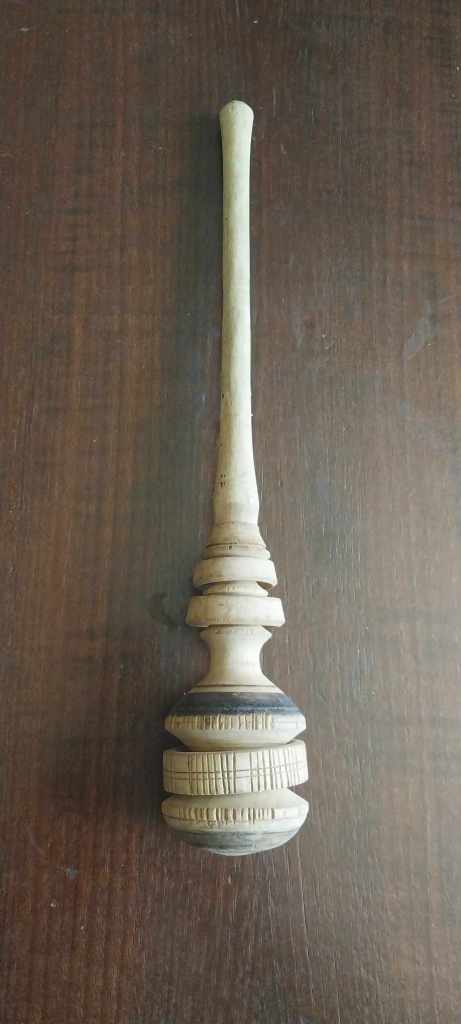

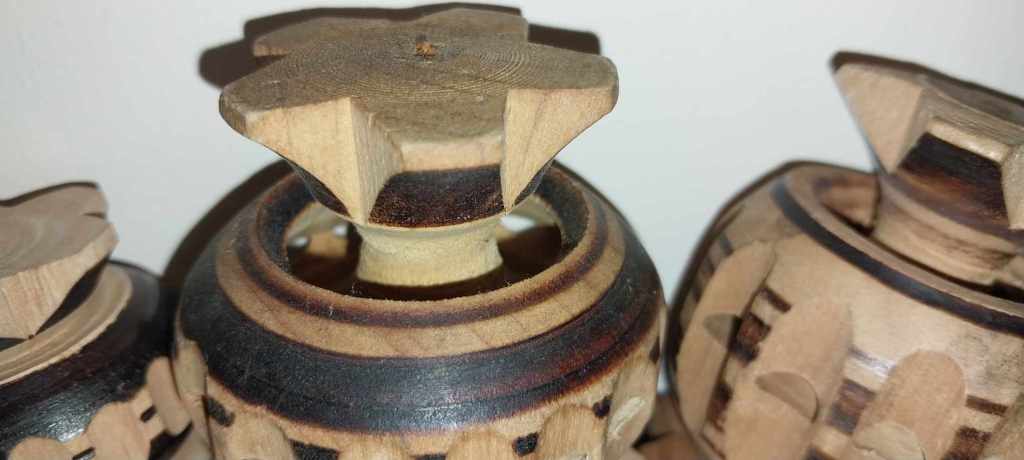
Judging by the colouration of the wood and the damage/wear on the molinillos I can assume them to be quite old and as the appear to have never been used to mix chocolate I also assume that they were likely once picked up as souvenirs by a traveller. They are unusual in that, unlike the others in my collection, they are solid and do not contain the hollow cavities typical to Mexican molinillos. These cavities create a process of cavitation (1) which encourages the foaming of chocolate.
- Cavitation in fluid mechanics and engineering normally refers to the phenomenon in which the static pressure of a liquid reduces to below the liquid’s vapour pressure, leading to the formation of small vapor-filled cavities in the liquid

I’ve now only just realised something as I type this. I mentioned atole before and there being no need for a molinillo to create foam. For those unaware, atole is a drink made from dissolving masa in liquid and mixing it into a drink.

The word “gruel” is often used to describe atole but I find that this word, apart from its negative connotations, falls far from the mark in describing atole. Atole can be as thin as water or thick enough to almost be eaten with a spoon, it can be either sweet or savoury and, in most cases (1) is a smooth textured liquid.
- except this case….Atole de Grano…where the smooth masa also contains partially ground (or not ground at all) nixtamalized corn kernels.

These molinillo do have the free floating rings typical to those used to foam chocolate.
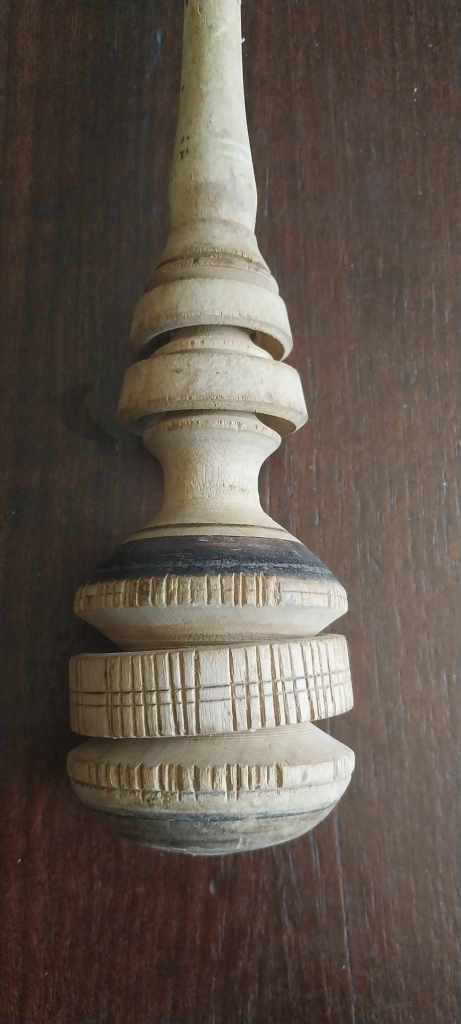

They appear to be quite old and to have been bashed about a bit during their journeys. Aside from this they seem quite clean though. A molinillo tends to become chocolate stained if used regularly.

My new additions appear to have never been used to mix chocolate and aside from the stain of age upon the handles, they appear to have never been used at all. Even the dye used to stain the molinillo on the left is fading with age. I’m only assuming its a dye as most of what I’ve seen shows these coloured areas to be “burned” onto the body of the molinillo by using another piece of wood which is pressed against the molinillo as it spins on the lathe. Check out Juan at https://www.youtube.com/watch?v=k7K43uE4Fr8 to see what I mean (its at the 40 second mark)


The work on these is also not as fine or decorative as on the others in my collection. My mind comes up with a couple of possible reasons for this. 1. They are simple utilitarian kitchen tools and 2. are not as decorative because they are quite old and perhaps they were produced in a time or area that did not cater to tourism.
Now for something slightly odd – and I might need a curandera for this one – last night I dreamt that one of my new molinillos (the one shown in the images on the right) had broken. It was hanging in its place but the head of the molinillo was broken almost completely off and was hanging on only by splinters of shattered wood. This seemed slightly ominous to me at the time.
A quick Google search of dream interpretations didn’t really help either. Standard self growth stuff really (I mean we could all probably do with some of this anyway)
- Dreams of tools signify your street smarts and coping mechanisms for life, your resources, and formula for handling challenges. If your tools are in good shape, then you are prepared to take on your life challenges. If your tools are broken or ineffective, this dream is telling you that it’s time to learn a whole new set of tools. Keep in mind that every challenge you face affords you a new opportunity to discover a new tool.
- Kitchen utensils are associated with changes you are making. You use them to take what you need in order to find nourishment and self worth. Like food, the symbolism is exploring fulfilment.
- Dreams about broken cooking tools or dull knives can indicate difficulties in achieving your goals.
- Broken Wood is a premonition for the two different aspects of your life. You need to release some of your pent up feelings and confront the issues that are causing much internal conflict. You need to clear your mind and free yourself of certain emotions that are weighing you down. Your dream stands for creation, childbirth, fertility and new beginnings. There are a lot of things to look forward to in the near future.
- Elements of a dream often represent a part of the dreamer. Therefore, a broken thing in a dream can represent a “broken” part of you. Dreaming of broken things, may mean you are devastated, strangely detached, or even relieved or elated. You may want to fix the broken thing, hide it, forget it or simply not care what happens to it anymore.
 Masa Americana