

I would like to look at some interesting information regarding a little known (to me) statue of Xochipilli that has recently been mentioned by two history related sites (1)(2)
- Tetzcoco Prehispánico on Facebook : a site dedicated to “Creating an awarness of and to disseminate the pre-Hispanic past of the eastern region of the Basin of Mexico”.
- Texcoco en el tiempo on Facebook and at (https://www.texcocoeneltiempo.org/) “Texcoco en el Tiempo is a citizen project that emerged in 2012 with the aim of preserving, documenting and disseminating the past of the Acolhuacan region, through collaboration with its inhabitants and specialized people who are interested in related topics.”
The Posts I speak of.
via Tetzcoco Prehispánico on Facebook
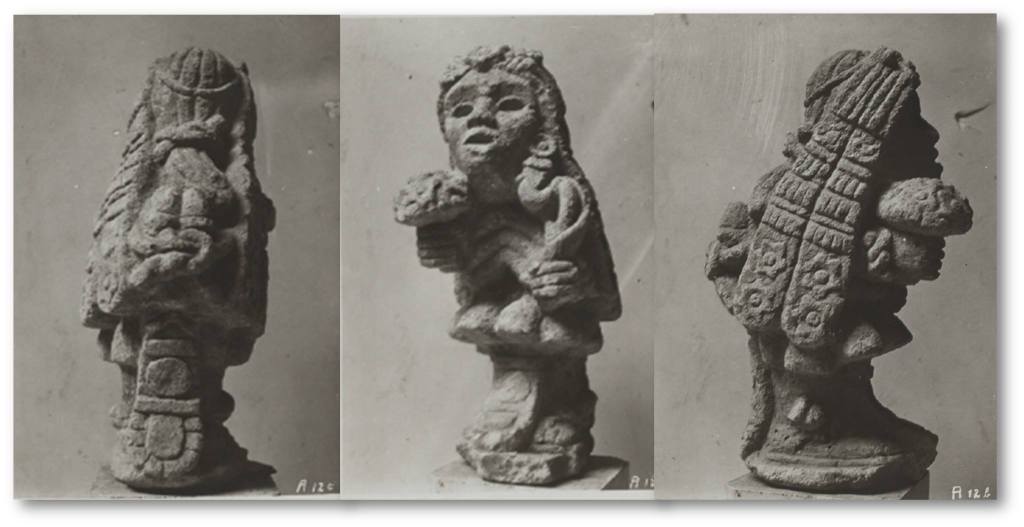
SCULPTURE OF XOCHIPILLI, HUEXOTLA.
Image: Wilhelm Bauer 1901 – 1910
This beautiful tezontle (1) stone sculpture, from Huexotla (2), State of Mexico, measures 15.5 x 11 cm. Undoubtedly, it is the standing representation of the deity of flowers, “Xochipilli”; at the end in his side headdress the ololiuhqui flowers can be seen and in his right hand he holds a large mushroom, iconographic elements that identify this deity.
Currently this piece from the Acolhua region is reported with the number: IV Ca 8393, in the Collection of the Museum of American Ethnology, of the Prussian Cultural Heritage Foundation, in Berlin, Germany.
- Tezontle (from Nahuatl tezontli) is a porous, highly oxidized, volcanic rock used extensively in construction in Mexico. It is usually reddish in colour due to iron oxide. “Tezontli is the local term for very spongy volcanic rock that occurs in a wide variety of sizes that was used from Tlamimilolpa ceramic phase through the Metepec phase for subflooring, for fill, and cut into facing stone for walls.” The Teotihuacan Valley Project Final Report: The Toltec Period of the Valley (Department of Anthropology, Pennsylvania State University, 1987)
- Huexotla or Huejotla is an archaeological site located 5 kilometers south of Texcoco, at the town of San Luis Huexotla, close to Chapingo, in Mexico State. Huexotla is considered to hold vestiges of the most important ancient Acolhuacan reign in the east of the Mexico highlands plateau.

via Texcoco en el tiempo on Facebook
Photo of a Xochipilli representation found in Huexotla, Texcoco, 1901. She holds a mushroom in one of her hands. The mushroom appears to have, on top, ololiuhqui flowers, perhaps indicating that it is one of the so-called teonanacatl. In the other hand he holds a rocatraz (1) or huacalxóchitl that seems to spring from his touch. That’s in line with Xochipilli’s attributes, as huacalxóchitl is related to sensuality and fertility.
- El Corazón De Huitzilin (on Facebook) notes rocatraz as being alcatraz
Our first impression was that the piece was lost, since in the collections of the Ethnological Museum of Berlin there were only these photos, taken by the ancient Wilhelm Bauer, who took several pieces from Mexico to sell them. Investigating a little more we realized that it is in the collection of the National Museum of Anthropology of Mexico, although it is poorly classified since it refers to being from Tlalmanalco (the documentation attached to the images seems to be very clear about his origin in Huexotla), something usual in some pieces from the museum’s old collections (archaeologist Colonel reminds us that there are pieces found in El Gavilán, Texcoco area, that were geographically linked to Teotihuacán, for example). The funny thing is that Bauer took these photos and they are in Germany, was this Xochipilli in Bauer’s possession at some point and tried to sell it, sending the photos? For some reason it stayed in Mexico and is now in the museum.
Friends of Tetzcoco Prehispánico had already written something about this piece, but they also thought it was overseas.
Note: We exaggerated the lower part of the mushroom with the red contour. This in favor of clarity.
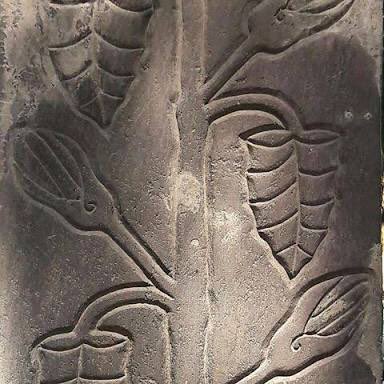
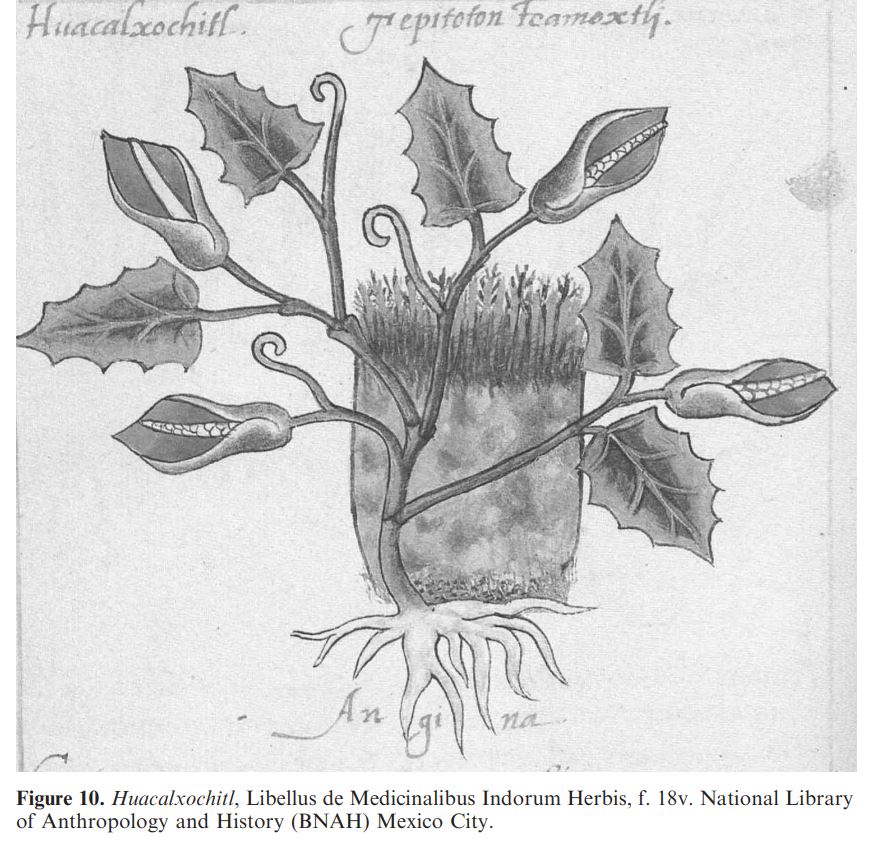

Huacal – Xochitl
also called the Alcatraz flower
Variously identified as Xanthosoma species, Zantedeschia species, and Philodendron species.

The Florentine Codex records four varieties of huacal – xochitl
Vacalsuchitl : Flor (flower) huacal. Its stems are like ropes. Throws tendrils. It has leaves. Its foliage is wide. Its leaves are like those of the ayozonan [perhaps Cucurbita sp.], bright, tender, very ribbed. Its stems are very long. Its leaves are creeping, climbers, overcomers of heights. Its flowers are cylindrical; They are cracked to the inside. Its center [its spadix] stands up; It also has its center [floral rachis]. [The spadix] is rounded, pointed, resinous. The skin of this flower is thick. Climb. It’s like rope; very similar to strings; it does ropes. It is roasted [with the tendrils].
Teccizoacalxuchitl : Caracola (Conch shell) Huacalxóchitl. Its stems are fat. Its leaves are very wide. Its flowers are fat, white, long. It does not smell good; It has no aroma; It doesn’t have a good smell. Whoever smells it will your nose expands, your nose becomes fat. Nowhere is it desired. Apparently the women of the palace wanted to obtain it, who were locked up, the women of Motecuhzoma. Saying With them they achieved sexual sensations. For this they were those who took care of the gardens and the women were stoned to death. [The ic expression tlalticpac tlamatque, which we have translated “with “they achieved sexual sensations”, includes the verb mati in its meaning of “feel” and tlaltícpac (“worldly”) in its sexual meaning.]
Tochnacazoacalsuchitl : Rabbit ear Huacalxóchitl. It is common. It is smelly, perfumed, aromatic. It’s good, fine.
Tlapalhoacalsuchitl : Red Huacalxóchitl . It is bright red. It is common. Is precious, required. I look for it for myself; I appropriate it; I’ll take it.
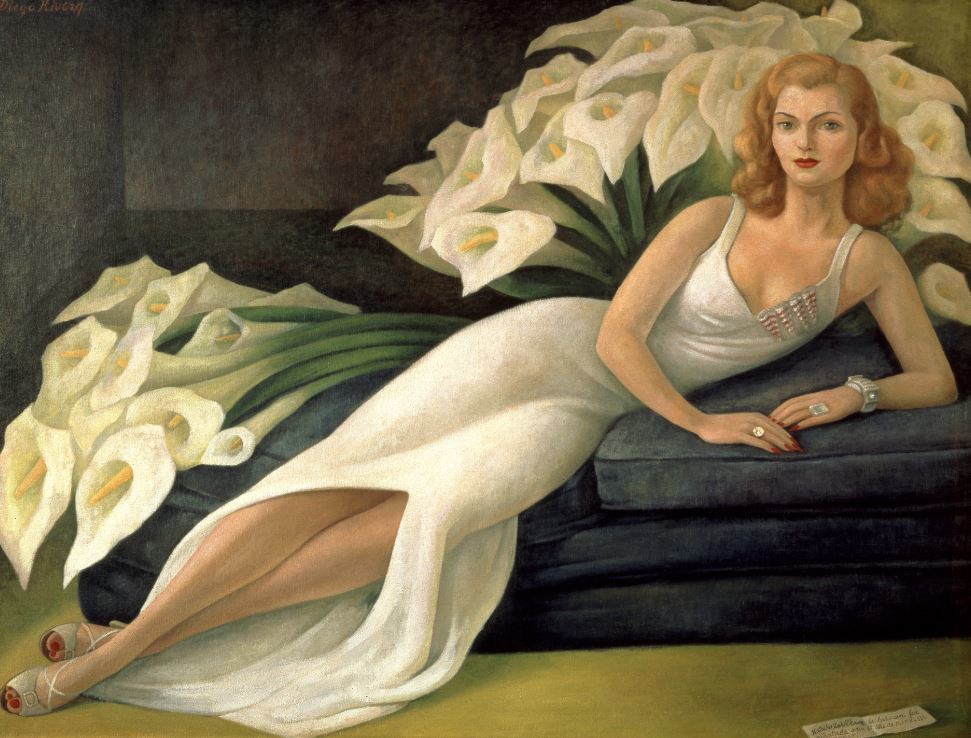
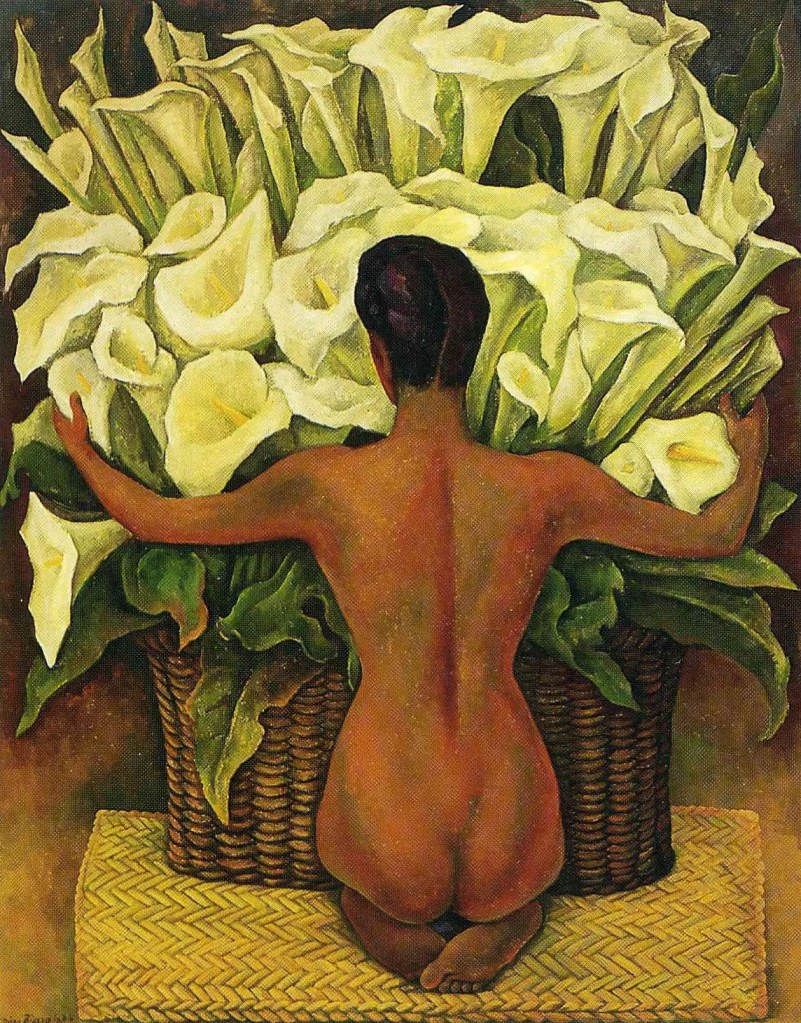
The artist Diego Rivera featured this flower in many of his works
INAH (1) has this to say of the carving.
- LOCATION : Anthropology National Museum
- PHYSICAL DESCRIPTION : FORM : Deity or supernatural sculpture (14″) 14.4cm 20.9cm
- SOURCE : Tlalmanalco, State of Mexico, Mexico (2)
- CREATION DATE 1250 1521
- ANTHROPOMORPHIC SCULPTURE, WHICH REPRESENTS THE GOD XOCHIPILLI. SHE IS STANDING AND CARRIES FLOWERS IN HIS HANDS, WHILE ON HIS BACK HE CARRIES A BULK OF COBS. HE IS ATTACHED WITH DISCOIDAL EAR MUFFS WITH PENDANT (EPCOLOLLI), HE ALSO WEARS FLOWERS ON HIS FOREHEAD, AND IS DRESSED IN A SKIRT WITH BELLS AND MAXTLATL. PRESENTS REMAINS OF BLUE, BLACK AND RED PIGMENT
- PURCHASED, INHERITED COLLECTION A-1254
- Instituto Nacional de Antropología e Historia
- Texcoco en el tiempo (on Facebook) makes note of the label that says this carving was sourced from.
Tetzcoco Prehispánico notes that “at the end in his side headdress the ololiuhqui flowers can be seen and in his right hand he holds a large mushroom“. For comparison I have shown below the flowers on the head dress (image on left ) and the mushroom in his hand (image on the right). As for the identification of ololiuhqui flowers I am not convinced at this stage and I do not believe the item in his hand is a mushroom as much as it appears to be a bunch of the very same flowers shown on the head dress. If you look at the rearview of the object as supplied by Texcoco en el tiempo in his hand it might be construed as a mushroom but it appears worn or damaged and should not (I think) be used as a positive identification for anything. There is room in my mind for the possibility it might be a peyote button but I’m really leaning toward it being a bouquet of the same flowers on the head dress. The flowers on the head dress however have 6 petals and the ones in the bouquet only five so there are differences that require investigation.
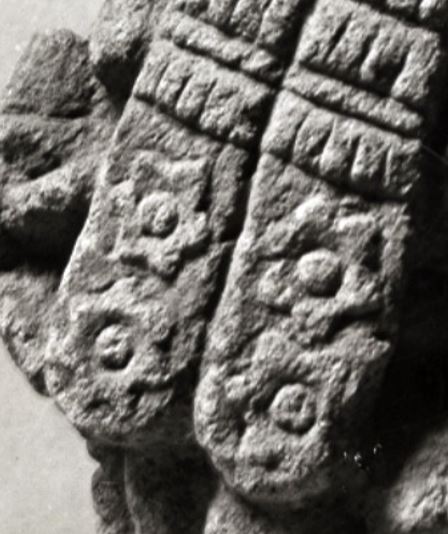

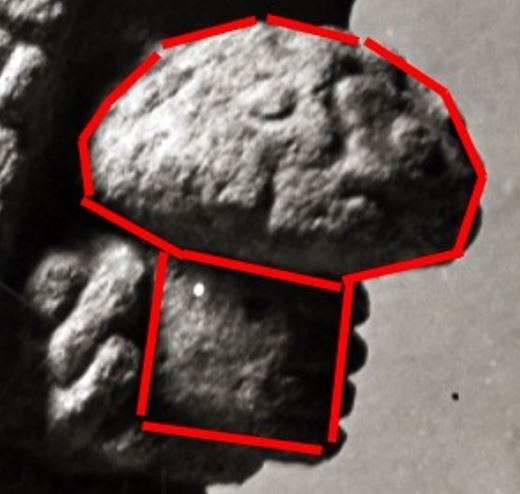
Ololiuhqui
According to Wiki the Nahuatl word ololiuhqui means “round thing”, and refers to the small, brown, oval seeds of the morning glory, not the plant itself, which is called coaxihuitl (“snake-plant”) in Nahuatl.
The Nahuatl dictionary describes ololiuhqui thusly…..
Turbina Corymbosa, a plant whose seeds are like those of the Morning Glory; from these seeds, Nahua women produced an alcoholic or narcotic beverage (see attestations); the seeds contain a narcotic that have a similar effect as peyote.
- Bartolomé de Alva, A Guide to Confession Large and Small in the Mexican Language, 1634, eds. Barry D. Sell and John Frederick Schwaller, with Lu Ann Homza (Norman: University of Oklahoma Press, 1999)
The so-called ololiuhqui is a seed like lentils or lentil vetch which, when drunk, deprives one of judgment. They consult it like an oracle for everything whatever that they want to know, even those things which are beyond human knowledge. (Atenango, between Mexico City and Acapulco, 1629)
Hernando Ruiz de Alarcón, Treatise on the Heathen Superstitions That Today Live Among the Indians Native to This New Spain, 1629, eds. and transl. J. Richard Andrews and Ross Hassig (Norman and London: University of Oklahoma Press, 1984), 59.
The same Nahuatl dictionary has no entry for coaxihuitl
xihuitl is said to translate to…..plant/herb : herbs (sometimes psychedelic) and other greenish things, such as grass, greenstone, and (importantly) turquoise : year (the calendar of 365 days) : flame, fire; or, the color and heat of a blue flame : the color blue (although you are more likely to see it as texotli in this particular iteration)
coa is a different story. I could find no direct translation except that of the farming implement known as a coa (a type of digging tool). Coa may be the prefix coatl which refers to : snake, serpent; twin, twins; also, a calendrical marker
Perhaps all of this leads us to a green – serpent like – climbing vine?
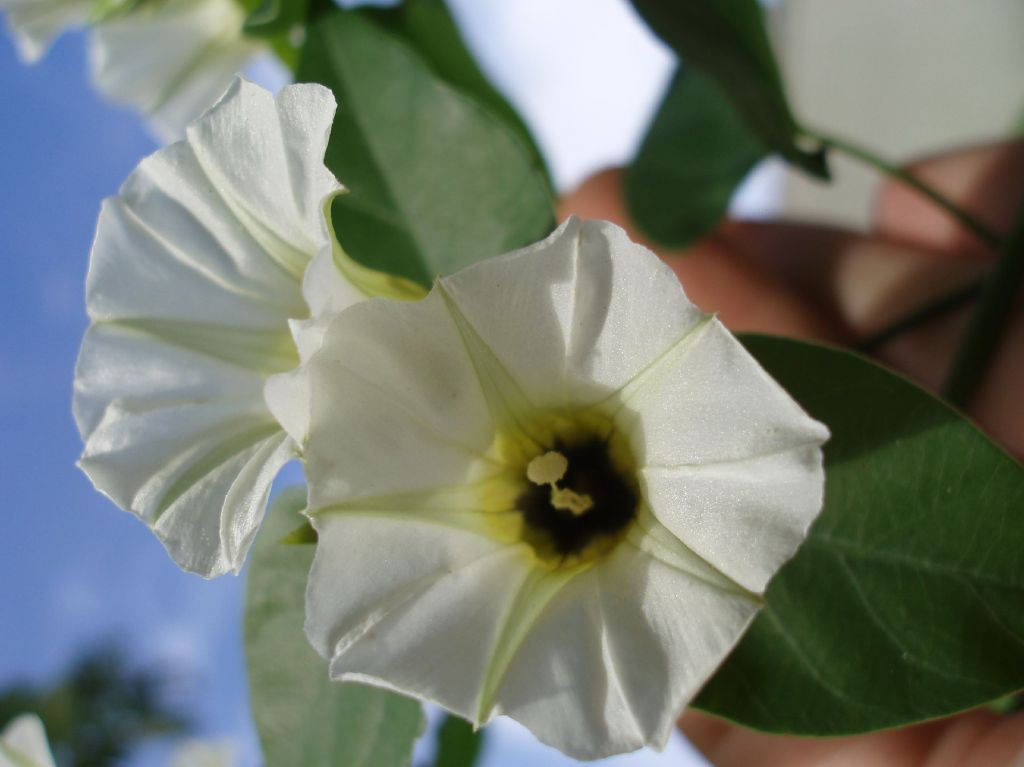


INAH notes the name coaxihuitl as meaning : Planta medicinal cuyas hojas son como las del hipericón (Medicinal plant whose leaves are like those of the hypericon)
In Mexico the seeds of various species of Ipomoea have been used for preparing psychedelic infusions; several scientific studies indicate they contain several ergoline alkaloids with effects somewhat similar to, but weaker than, those of LSD. This fits with one of the claims that Xochipilli is a God of “flowers that intoxicate”.
One of the most interesting things about this last Post was the reference material used by the author.
One reference in particular, Fernández (1959) contained within it a reference to the floral adornment of the base of Xochipillis statue.
“The statue of Xochipilli is composed of two separate carved items. The first (and most often examined) is the seated, cross-legged figure of Xochipilli and the second is the carved base upon which he sits“. Fernández notes “it should be noted that the base and the figure itself are two independent pieces, but they form an indivisible unit both artistically and conceptually.” and of the base “in the center of each of its four faces it bears a large flower, in the lower part of which there is, as if sucking on it, a butterfly, in profile, and its head has one eye and its open snout and fangs. It also has a small arm with claws and as a whole it reminds the monster of the earth, T.laltecuhtli, also Cipactonal or Cí¬pactonalli. On one of the sides there are two more butterflies, similar to the previous one, which are found on either side of the large central flower and over them runs a kind of wavy cord that forms hanging waves and suggests an aquatic symbol. Finally, at the top, it is decorated with a row of small discs highlighted with a dot in their center, like those that represent, in other cases, solar symbols. On other sides of this base body instead of the side butterflies are four disks or dots, sun signs as well.”
This reference text also had within it a poem to Xochipilli, or rather, “a sacred ode to the god of joy, music and all beauty: Xochipilli, by their calendrical names, 1-Flower, Ce Xochitl, or 5-Flower , Macuil xochitl, and in its reality the sun itself (1), in its aspect of giver of life and of the joy that accompanies living. “Young prince”, Piltzintecuhtli, is the one who shines in the world and shines in the soul”. (Fernández 1959)
- Xochipilli is not only “the flower prince”, but the rising sun, the child sun, the god of light, life, games, poetry and art; he is, therefore, above all, a solar god. Dr. Alfonso Caso in The religion of the Aztecs (Mexico, 1936, p. 26), says that it is the “patron of dances, games and love, and the representation of summer”, which “is rather a solar deity and its symbol is formed by four points that are called tonollo and mean solar heat, since it is the god that represents summer. Fernandez furthers this by saying “In the plane of phenomenal physical reality, Xochipilli is the rising sun, therefore in close relationship with the earth, especially on the horizon, where the earth appears mossy and humid, but full of Life, plant and animal. Thus, it is not surprising that in the plane of myth he was conceived as the child sun as a young man, with a pale red body, adorned with flowers and butterflies, with the four points as his symbol, tonallo, since means the solar heat”
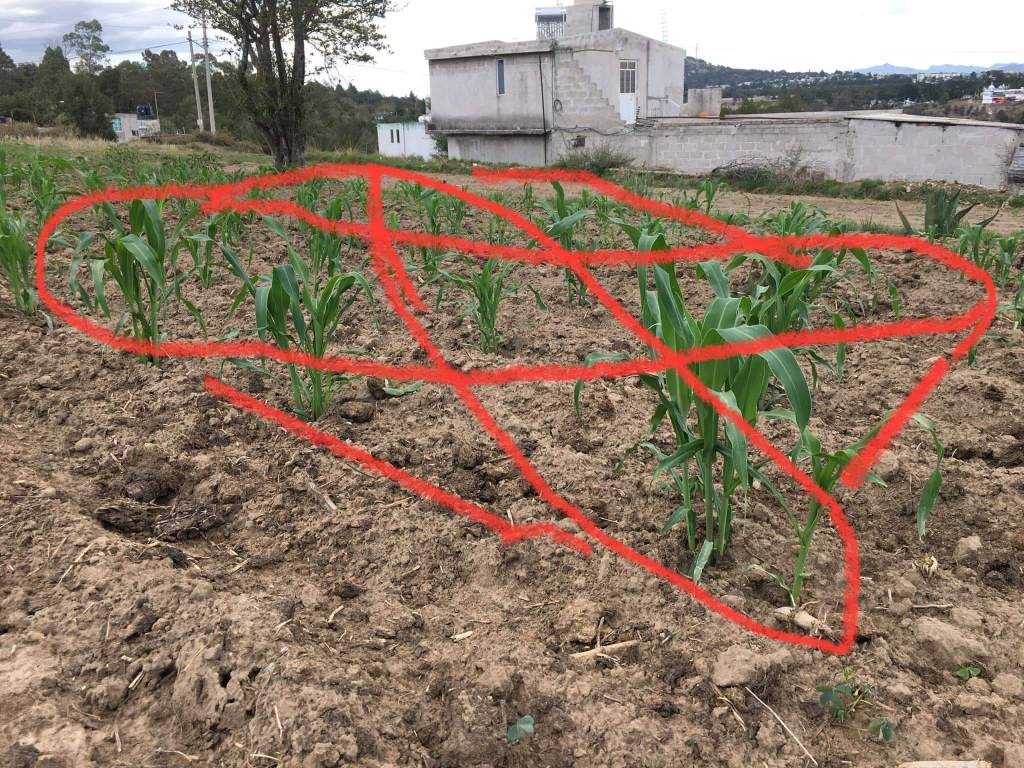
As an interesting (and possibly unrelated) aside I bring to you an example of indigenous planting practices from Tlaxcala which demonstrates an example of the close relationship between the sun and the earth. This process (called encoatar or uncuatar) encompasses both philosophical and mathematical knowledge and deserves deeper investigation.
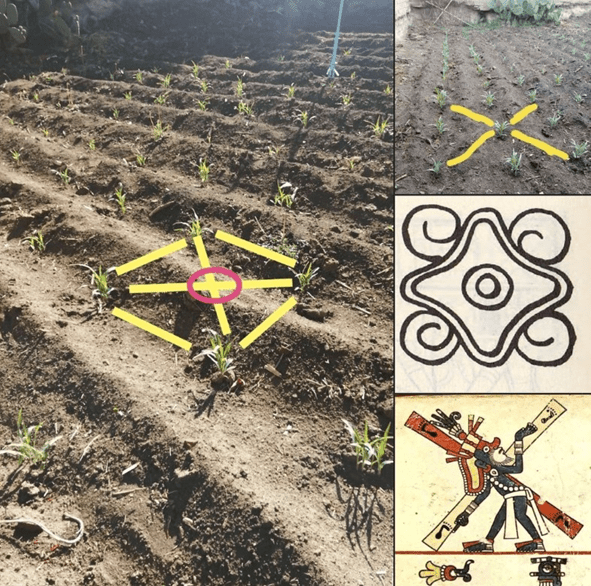
The image is said to reflect the cross of Quetzalcoatl. The quincunx design and the relationship between the sun, the earth and the sprouting of seed carries a deeper meaning which certainly lies within the realm of the god of the sprouting seed, Xochipilli.


The cross symbol was also representative of the planet Venus and was widespread in Mesoamerica.

Art Symbols Of The Greater Southwest 1997


symbol. Redrocks, AZ.
Photo Paul and Joy Foster
All very interesting but lets get back to the poem. This poem divulges another (non-hallucinogenic) candidate for the identity of Xochipilli’s floral adornment.
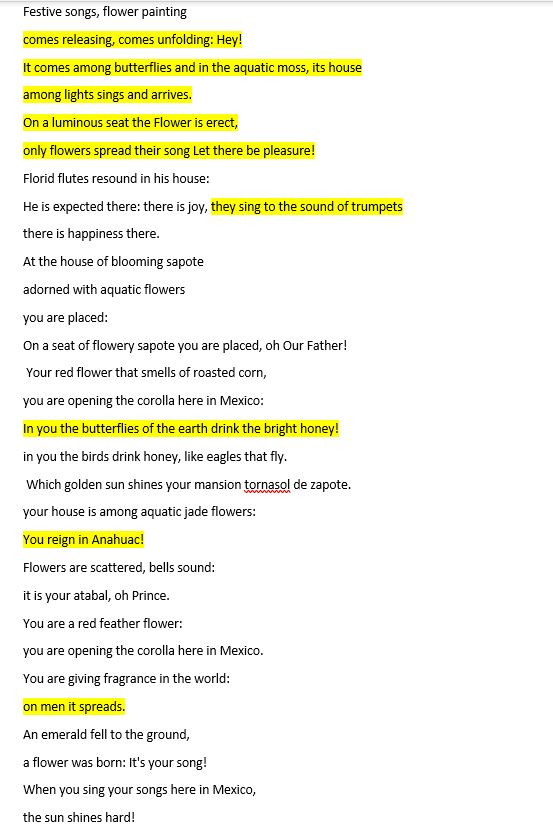
The Poem
Cantos festivos, pintura de flores
viene soltando, viene desplegando: ¡oídIo!
Tiene entre mariposas y en el musgo acuático su casa
entre luces canta y llega.
Sobre luminoso sitial está erguida la Flor:
sólo flores esparce su canto. Haya placer!
Floridas flautas resuenan en su casa:
allí es esperado El: hay gozo, se canta al son de trompetas
hay felicidad allí .
En casa de zapote enflorado
adornada con flores acuáticas
estás colocado: ¡en asiento de florido zapote estás puesto, oh padre nuestro!
Tu roj a flor que huele a maíz tostado,
estás abriendo la corola aquí en México:
en ti beben la miel brillante mariposas de la tierra!
en ti beben la miel las aves, como águilas que vuelan.
Cual sol de oro brilla tu mansión tornasol de zapote.
tu casa está entre flores acuáticas de jade:
tú en Anáhuac imperas!
Se esparcen flores, suenan cascabeles:
es tu atabal, oh principe.
Tu eres roja flor de pluma:
abriendo estás la corola aquí en México.
Estás dando fragancia en el mundo:
sobre los hombres se difunde.
Una esmeralda cayó al suelo,
nació una flor: tu canto!
Cuando entonas tus cantos aquí en México,
el sol dura brillando!
Various translations showing (minor) differences in the wording
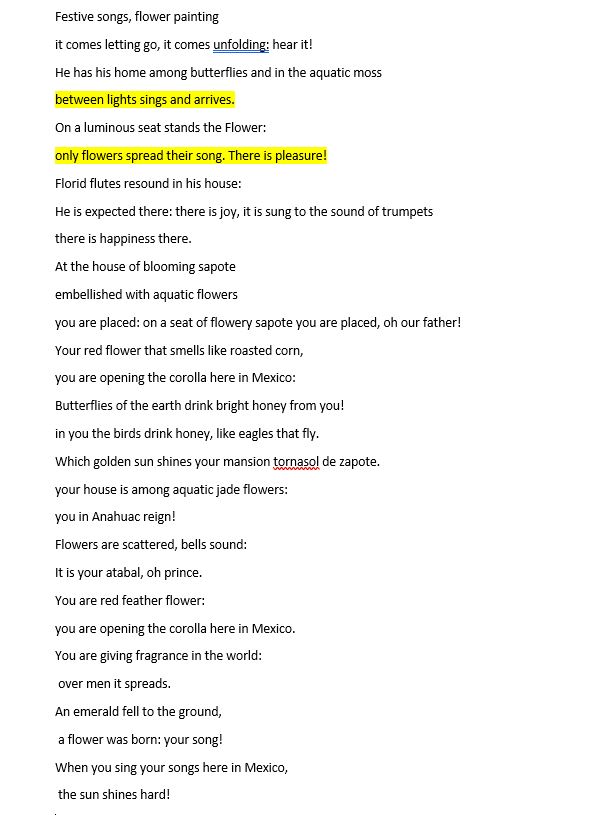
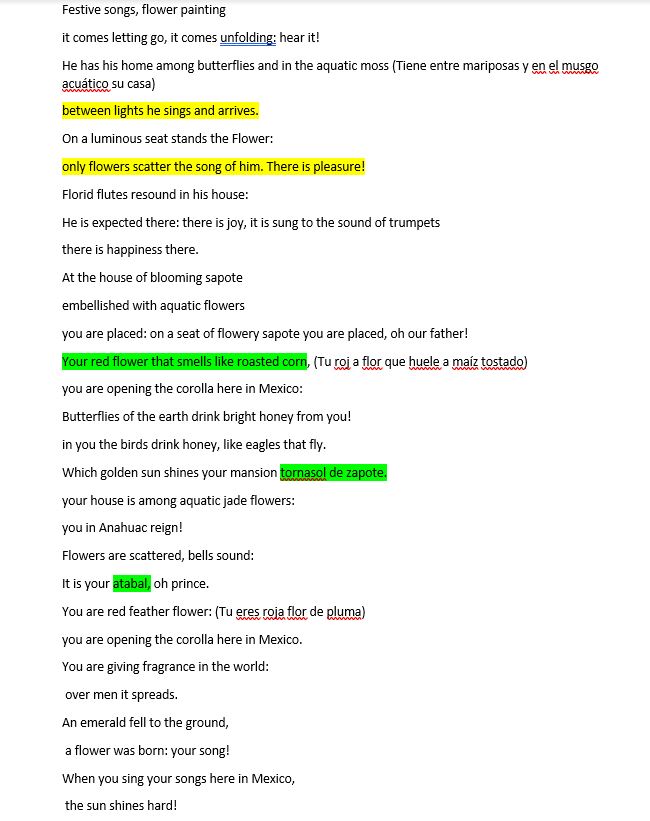
A couple of translatory delvings
Tornasol : Latin American Spanish
(masculine noun)
- (Botany) sunflower
- noun. litmus [noun] a dye obtained from certain lichens that turns red when it touches an acid and blue when it touches an alkali.
- (Chemistry) litmus
papel de tornasol litmus paper - (figurative) sheen ⧫ iridescence
Is Xochipilli acidic? He is often depicted with red facial paint. More likely it refers to the “iridescence” of Xochipillis mansion the “house of the blooming sapote” (adorned with/embellished aquatic (jade) flowers) within which he sits upon “a seat of flowery sapote”.
Atabal : Borrowed from Spanish atabal, from Arabic الطَّبْل (aṭ-ṭabl, “drum”)
1843 — … the Tlascalans set up their yell of defiance, rising high above the wild barbaric minstrelsy of shell, atabal, and trumpet, with which they proclaimed their triumphant anticipations of victory over the paltry forces of the invaders. — William H. Prescott, History of the Conquest of Mexico, Book 3, Chapter 3
No doubt part of the musical nature of this god of festivities along with the trumpets, bells and “florid flutes”

The base is most interesting. It is the seat upon which Xochipilli rests and is variously described as……
- “on a luminous seat stands the Flower” (is “the Flower” Xochipilli?)
- a seat of flowery sapote
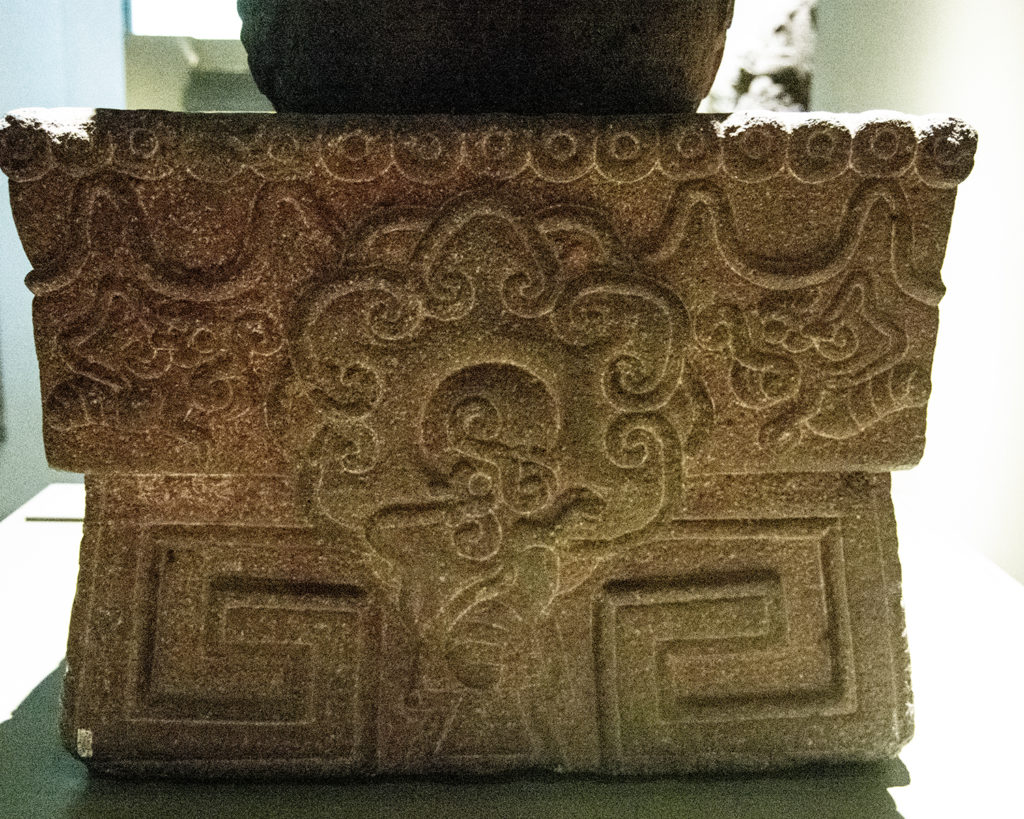


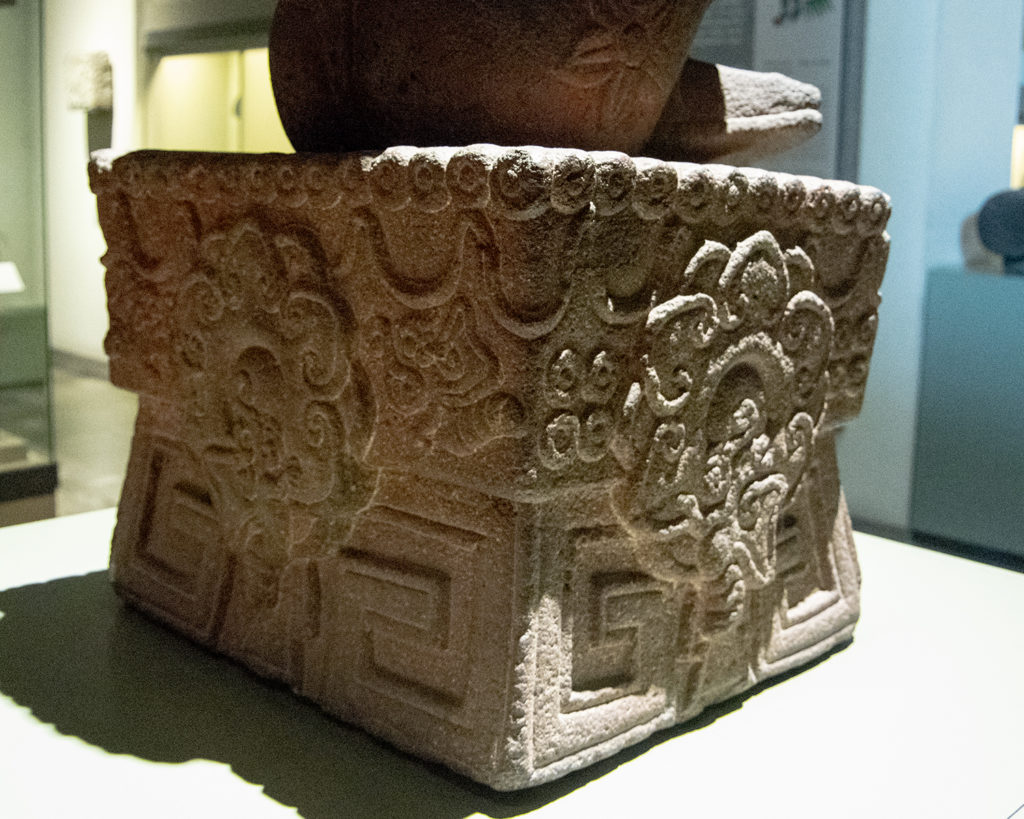

Fernandez explains of the base……”in the center of each of its four faces it bears a large flower, in the lower part of which there is, as if sucking on it, a butterfly, in profile, and its head has one eye and its open snout and fangs. It also has a small arm with claws and as a whole it reminds the monster of the earth, Tlaltecuhtli, also Cipactonal or Cípactonalli. On one of the sides there are two more butterflies, similar to the previous one, which are found on either side of the large central flower and over them runs a kind of wavy cord that forms hanging waves and suggests an aquatic symbol. Finally, at the top, it is decorated with a row of small discs highlighted with a dot in their center, like those that represent, in other cases, solar symbols. On other sides of this base body instead of the side butterflies are four disks or dots, sun signs as well.“

Fernández (1959) makes some observations (in italics) about the statue. My notes are in BOLD.
1. He has his house in the aquatic moss, among butterflies. (Remember the upper body of the sculpture base.)
chalchihuitl.
Principal English Translation:
a precious stone, especially a precious green or blue stone; also, part of a metaphor for a newborn baby, child
Susan Kellogg, Law and the Transformation of Aztec Culture, 1500-1700 (Norman and London: The University of Oklahoma Press, 1995), 222.
Orthographic Variants:
chalchiuitl, chalchiuhtli
2. On a luminous chair stands the Flower. (Corresponds to the figure on the base or seat on which it stands; perhaps the discs on the edge of the seat are both precious jade objects and solar symbols.)
3. In the house of sapodilla, adorned with aquatic flowers. (Remember the second body of the base, adorned with large flowers: … you are sitting on a seat of flowery sapote…!
4. Butterflies of the earth drink bright honey from you. (Remember the butterflies on the second body of the base and especially those found on the large central flowers on each of the four sides; furthermore, the butterflies in the sculpture recall the earth monster due to their snouts and claws. )
5. Your house is among aquatic jade flowers. (New allusion to the forms that appear at the base of the sculpture.)
6. When you sing your. songs… the sun shines hard. , (Will the gesture of ochipi’s mouth respond to her singing some song? In any case, the look up seems to prolong her momentary attitude, beyond.) (Fernández 1959)
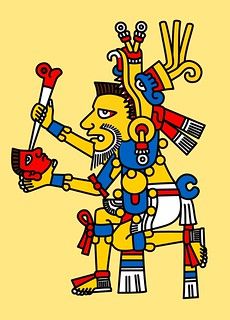
Codex Fejervary Mayer 23
Cipactonal is the Aztec god of astrology and calendars. Oxomoco and Cipactonal were said to be the first human couple, and the Aztec comparison to Adam and Eve in regard to human creation and evolution. They bore a son named Piltzin-tecuhtli, who married a maiden, daughter of Xochiquetzal. (Austin 1988) (Austin 1996)

Oxomoco (also known as Oxomo) (Otilia Meza 1981) is an Aztec deity, the goddess of the night, the astrology and the calendar. Oxomoco and Cipactonal were said to be the first human couple, and the Aztec comparison to Adam and Eve in regard to human creation and evolution.(Austin 1988) (Austin 1996) They bore a son named Piltzintecuhtli, who married a maiden, daughter of Xōchiquetzal. As an older woman she was also known as Itzpapalotl (Austin 1996)


Tlaltecuhtli is a pre-Columbian Mesoamerican deity worshipped primarily by the Mexica (Aztec) people. Sometimes referred to as the “earth monster,” Tlaltecuhtli’s dismembered body was the basis for the world in the Aztec creation story of the fifth and final cosmos. In carvings, Tlaltecuhtli is often depicted as an anthropomorphic being with splayed arms and legs. Considered the source of all living things, she had to be kept sated by human sacrifices which would ensure the continued order of the world.
According to a source, in the creation of the Earth, the gods did not tire of admiring the liquid world, no oscillations, no movements, so Tezcatlipoca and Quetzalcoatl thought that the newly created world should be inhabited. And for this, they made Tlalcihuatl, ‘Lady of the earth’, come down from heaven, and Tlaltecuhtli, ‘Lord of the earth’, would be her consort. (Otilia Meza 1981). Tezcatlipoca and Quetzalcoatl create the Earth from the body of Cipactli, a giant alligator self-created in the Omeyocan.
Cipactonalli


Weather is the condition of the environment at a given time and place. The name given to the space between the ground and the moon is called CIPACTONALLI and is divided into 5:
- xopalixtli (legs),
- Ihtetl (belly),
- nacayotl (body),
- cuetzpamitl (tail) and
- tapachtli (the scales) See Fig. 1
Most of the weather conditions occur in XOPALIXTLI , which is the lowest layer of the cipactonalli, it is here where the MIXCOATL (cloud serpent) is found, which is the one that carries the highest concentration of water in the environment, in it the horizontal and vertical movements of the 4 wind serpents that transmit the energy of TONATIUH , each leg of the cipactonalli is a different wind serpent. See Fig. 2. The xopalixtli is the zone of climatic phenomena: rains, cold winds, hailstorms, snowfalls, drizzles, storms, among others.
(milkwaxotl)
At his house of the blooming sapote adorned with aquatic flowers, among the butterflies and in the aquatic moss
Tzapotl (1) : The Sapote
The common name sapote (2) refers to any soft, edible fruit.
- the word tzapotl was latinized into zapotl, zapota, sapota, zapote, and sapote
- from Nahuatl “tzapotl “, (Tlaxcala): tsapotl. (plural tzapome)


Black sapote – Diospyros nigra, the black sapote, is a species of persimmon. Common names include chocolate pudding fruit and zapote prieto. The tropical fruit tree is native to Mexico, Central America, and Colombia. Black sapote is not related to white sapote nor mamey sapote.
Black sapote is probably the original Aztec tzapotl.
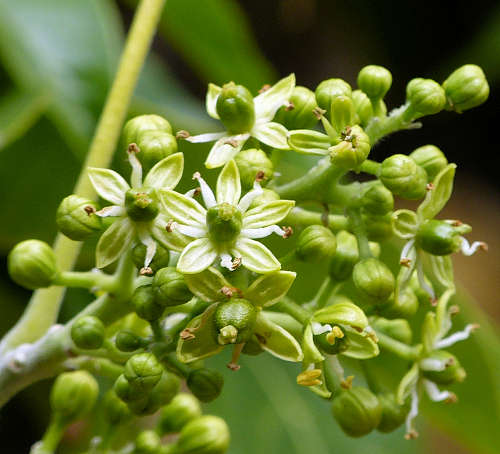

White sapote – The white sapote, scientific name Casimiroa edulis, also called casimiroa and Mexican apple,[1] and known as cochitzapotl in the Nahuatl language (meaning “sleep-sapote”) is a species of tropical fruiting tree in the family Rutaceae, native to eastern Mexico and Central America south to Costa Rica.


Mamey sapote – Pouteria sapota, the mamey sapote, is a species of tree native to Mexico and Central America.
Chicozapote (Manilkara zapota)


the chicozapote has stood out since prehispanic times because of the resin extracted from its bark. This latex, whose name in Nahuatl is tzictli (gum or “sticky stuff”) is these days called chicle and is the basis for a natural chewing gum

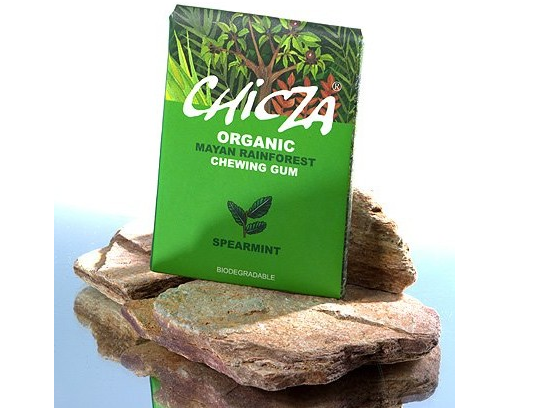
There is a resurgence within Australia for chicle based gums. This is probably why…..(see images below)


So. The product listed above consists of sweetener, gum base (1), sweetener, flavour, sweetener, sweetener, sweetener, sweetener, and something called BHT (?)
- ? perhaps this is chicle?
So what are these ingredients?
- Sorbitol – Sorbitol, less commonly known as glucitol, is a sugar alcohol with a sweet taste which the human body metabolizes slowly. Sorbitol can cause gastrointestinal symptoms (gas, urgency, bloating, abdominal cramps) in a dose-dependent manner (5 to 20 g per day). Doses of more than 20 g per day can cause diarrhoea (Liauw & Saibil 2019)
- Gum base – what is “gum base”? See image (direct from manufacturers website below this list)
- Glycerol – Glycerol, also called glycerine in British English and glycerin in American English, is a simple triol compound. It is a colorless, odorless, viscous liquid that is sweet-tasting and non-toxic. The glycerol backbone is found in lipids known as glycerides. Glycerol is taken by mouth for weight loss, improving exercise performance, helping the body replace water lost during diarrhoea and vomiting, and reducing pressure inside the eye in people with glaucoma. Athletes also use glycerol to keep from becoming dehydrated. Glycerol can also be used as a menstruum (in place of alcohol) when making herbal tinctures.
- Hydrogenated starch hydrolysate – Hydrogenated starch hydrolysates are produced by the partial hydrolysis of starch – most often corn starch, but also potato starch or wheat starch. This creates dextrins (glucose and short glucose chains). The hydrolyzed starch (dextrin) then undergoes hydrogenation to convert the dextrins to sugar alcohols.
- Aspartame – Aspartame is an artificial non-saccharide sweetener 200 times sweeter than sucrose and is commonly used as a sugar substitute in foods and beverages
- Mannitol – Mannitol is a type of sugar alcohol used as a sweetener and medication. It is used as a low calorie sweetener as it is poorly absorbed by the intestines (Varzakas etal 2012). Common side effects from medical use include electrolyte problems and dehydration. Other serious side effects may include worsening heart failure and kidney problems. It is unclear if use is safe in pregnancy
- Acesulfame K – Acesulfame potassium, also known as acesulfame K (K is the symbol for potassium) or Ace K, is a synthetic calorie-free sugar substitute (artificial sweetener). Acesulfame K is 200 times sweeter than sucrose (common sugar), as sweet as aspartame, about two-thirds as sweet as saccharin, and one-third as sweet as sucralose. Acesulfame K is often blended with other sweeteners (usually sucralose or aspartame). These blends are reputed to give a more sucrose-like taste whereby each sweetener masks the other’s aftertaste, or exhibits a synergistic effect by which the blend is sweeter than its components.
- BHT – Butylated hydroxytoluene, also known as dibutylhydroxytoluene, is a lipophilic organic compound, chemically a derivative of phenol, that is useful for its antioxidant properties. As an endocrine disruptor, it can impact testosterone levels as well as affect sperm quality. Another reason why BHT isn’t good for you is that it might cause enlargements in the liver, inflammatory effects in the lungs, renal dysfunction, and a decrease in potassium levels (Choe & Yang 1982). BHT is considered to be safe in cosmetic applications (Lanigan etal 2002). “BHT applied to the skin, however, appears to remain in the skin or pass through only slowly and does not produce systemic exposures to BHT or its metabolites seen with oral exposures“


The gum does tout itself as “sugar free”. Which is technically correct. It does however consist of half a dozen sweeteners, some of which have either known or conspiracy laden negative health effects.
Reference Texts
- Austin, Alfredo López (1988). The human body and ideology: concepts of the ancient Nahuas. University of Utah Press. p. 238. ISBN 978-0-87480-260-3. Retrieved 26 October 2011.
- Austin, Alfredo López (1996). The rabbit on the face of the moon: mythology in the mesoamerican tradition. University of Utah Press. pp. 102–6. ISBN 978-0-87480-527-7. Retrieved 26 October 2011.
- Case, Antonio. (1963). Mushroom representations in the codes. Nahuatl Cultural Studies, Vol. 4 pp. 27-35
- Castillo-Campos, Gonzalo & moreno casasola, Patricia & Laborde, Javier. (2016). III. BOSQUES Y SELVAS EN LAS DUNAS.
- Choe, S.Y.; Yang, K.H. (1982) Toxicological studies of antioxidants, butylated hydroxytoluene (BHT) and butylated hydroxyanisole (BHA) ; Korean Journal of Food Science and Technology (Korea R.) Volume 14 Issue #3
- Dehouve, D. (2020). THE RULES OF CONSTRUCTION OF AN AZTEC DEITY: CHALCHIUHTLICUE, THE GODDESS OF WATER. Ancient Mesoamerica, 31(1), 7-28. doi:10.1017/S0956536118000056
- Dubovoy, Celia. (1968). “Knowledge of mushrooms in Ancient Mexico”. Newsletter of the Mexican Society of Micology, Vol II, 1968, pp: 16-24.
- Fernández, Justino (1959) Una aproximación a Xochipilli; Estudios de cultura Náhuatl, ISSN 0071-1675, Nº. 1, 1959, pág. 4
- Granziera, Patrizia (2005). Huaxtepec: The Sacred Garden of an Aztec Emperor. , 30(1), 81–107. doi:10.1080/0142639042000324776
- Lanigan, Rebecca S, and Torill A Yamarik. “Final report on the safety assessment of BHT(1).” International journal of toxicology vol. 21 Suppl 2 (2002): 19-94. doi:10.1080/10915810290096513
- Liauw S, Saibil F. Sorbitol: Often forgotten cause of osmotic diarrhea. Can Fam Physician. 2019 Aug;65(8):557-558. PMID: 31413027; PMCID: PMC6693595
- Lopez Austin and Lopez Lujan (2017). “Alcatraz / Huacalxóchitl. Symbol of sensuality and instrument of pleasure”, in Mexican Archeology No. 147. If 18-27.
- Otilia Meza (1981). Editorial Universo México (ed.). El Mundo Mágico de los Dioses del Anáhuac (in Spanish). México. p. 47. ISBN 968-35-0093-5.
- Patterson, Alex (1992) A Field guide to rock art symbols of the greater Southwest : Johnson Books : Boulder : ISBN – 10 9781555660918
- Plowman, Timothy (1969). Folk Uses of New World Aroids. Economic Botany, 23(2), 97–122. doi:10.2307/4253029
- Sahagún, B. D. (1577) General History of the Things of New Spain by Fray Bernardino de Sahagún: The Florentine Codex. [Place of Publication Not Identified: Publisher Not Identified] [Pdf] Retrieved from the Library of Congress, https://www.loc.gov/item/2021667837/.
- Varzakas T, Labropoulos A, Anestis S (2012). Sweeteners: Nutritional Aspects, Applications, and Production Technology. CRC Press. pp. 59–60. ISBN 9781439876732.
- Watson, George (1938). Nahuatl Words in American English. American Speech, 13(2), 108–121. doi:10.2307/451954
Websites
https://apps.cals.arizona.edu/arboretum/taxon.aspx?id=439
https://mediateca.inah.gob.mx/islandora_74/islandora/object/objetoprehispanico:16787
https://milkwaxotl.wixsite.com/lenguaculturanahuatl/tcleccion-14
https://nahuatl.wired-humanities.org/content/ololiuhqui
https://www.confectionerynews.com/Article/2013/08/01/Chicle-gum-makes-renaissance-in-Australia
https://www.growables.org/information/TropicalFruit/MameySapote.htm
Xochipilli – The Aztec Prince of Flowers
 Masa Americana