

Anzuinelli and crew are at it again. Their botanical wanderings of Argentina has bought to light a new species of pore leaf. In July of 2024 Anzuinelli (et al 2024) published an article commenting on the cataloguing of a “new endemic species” of Porophyllum less than 6 months after doing the very same with Porophyllum iruyense.
They also had an interesting occurrence with the species Porophyllm cabrerae but more on that at the end.
Say hello to Porophyllum riparium
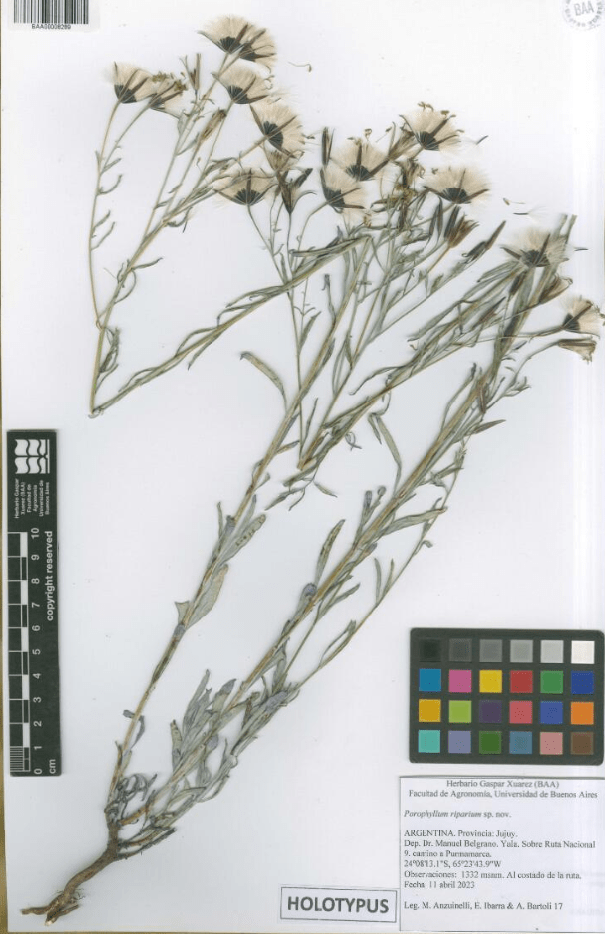
This new species occurs in the northwest region of Argentina, in Salta, Jujuy and Tucumán Provinces, in the Yungas biogeographical province.


Botanically speaking……Porophyllum riparium is characterized by being an annual or short-lived perennial, glaucous, odoriferous (1), monoecious herb (2) , 15–80(–130) cm tall, with sessile or attenuate into a pseudopetiole, linear-elliptic leaves with submarginal and subapical semi-pellucid oil cavities, lemon-colored infundibuliform corollas and exserted brownish anthers. This is pure botanical speak that will be outside the ken of most but those VERY specifically trained in such matters. I do go through some of these terms in other Posts and I place this here for those interested in such matters.
- one of my favourite words when it comes to the description of these plants. One thing that is always noted (and despised by many) is the strong scent of these plants (and which is one of the reasons I absolutely love this species)
- Monoecious – (of a plant or invertebrate animal) having both the male and female reproductive organs in the same individual; hermaphrodite. This is interesting as a little further down I’ll discuss something they noted regarding the sexuality of Porophyllum cabrerae.

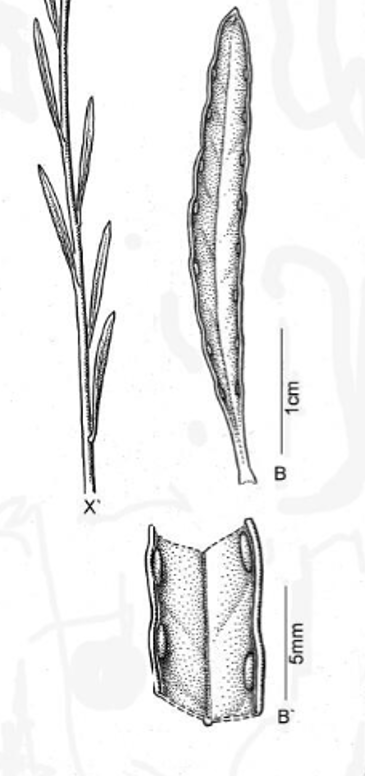

Pellucid – translucently clear.
In botany, “pellucid cavities” (also known as “pellucid dots” or “oil glands”) are translucent (1) or light-transmitting cavities, often found in the leaves of certain plant families
- translucent – allowing light, but not detailed shapes, to pass through; semi-transparent.


Porophyllum cabrerae
An addition to the article noted that the female plants of Porophyllum cabrerae were documented for the first time. Now this is interesting as in all my time studying the Porophyllums I have always known the plant to be monoecious (definition noted earlier) and this is the first time I have come across a dioecious (1)
- Dioecious – male and female flowers appear on separate plants (although in the image above both flowers seem to be on the one plant?)
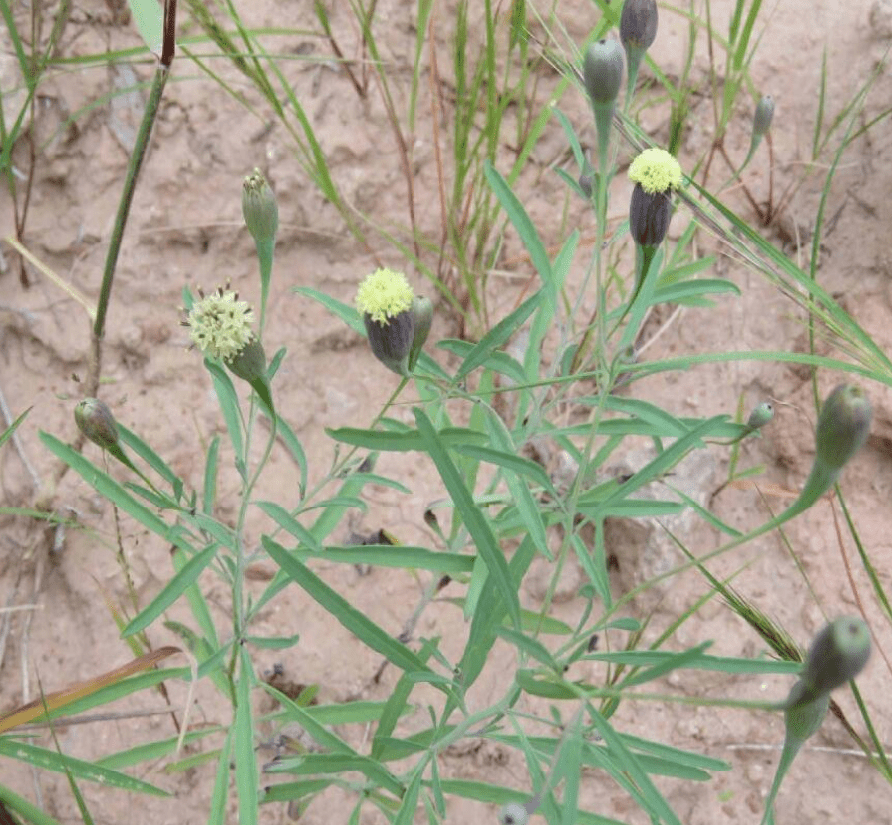
Porophyllum cabrerae (image above) Population with bisexual and female plants. (images below)


Capitulum – a compact head of a structure, in particular a dense flat cluster of small flowers or florets, as in plants of the daisy family.
There is also a 3rd category of plant sexuality (aside from monoecious and dioecious) and that is bisexual or hermaphroditic where each flower contains both male and female parts. This is pretty much any flower yes? well, no. The main difference is the frame of reference. “Monoecious” refers to a whole plant having both male and female parts, while “hermaphroditic” refers to an individual flower having both male and female parts.
Bisexuality amongst the Porophyllums. In this case Porophyllum spathulatum (1).
- See New(ish) Additions to the Poreleaf Family. for more on this plant

Porophyllum spathulatum (Carneiro et al 2014)
E. Bisexual heads showing the enlarged peduncle.
F. Pistillate head.
G. Bisexual floret (on the left) and pistillate floret (on the right).
H. Bisexual floret showing the anthers (on the left) and pistillate floret open, showing staminodes (on the right).
I. Cypsela and pappus.

References
Anzuinelli, Milagros & Schiavinato, Dario & Bartoli, Adriana. (2024). A new species of Porophyllum (Asteraceae: Tageteae) from the northwest of Argentina, and the first record of female plants of Porophyllum cabrerae. Phytotaxa. 660. 65-74. 10.11646/phytotaxa.660.1.6.
Carneiro, Camila & Schneider, Angelo & Ritter, Mara. (2014). Porophyllum spathulatum (Asteraceae: Tageteae), a new species from the southern Brazilian coast. Phytotaxa. 173. 157-162. 10.11646/phytotaxa.173.2.6.
Sandoval Salinas, María & Szumik, Claudia & Barquez, Rubén. (2010). Bats and marsupials as indicators of endemism in the Yungas forest of Argentina. Zoological Research. 31. 633-44. 10.3724/SP.J.1141.2010.06633.
 Masa Americana