
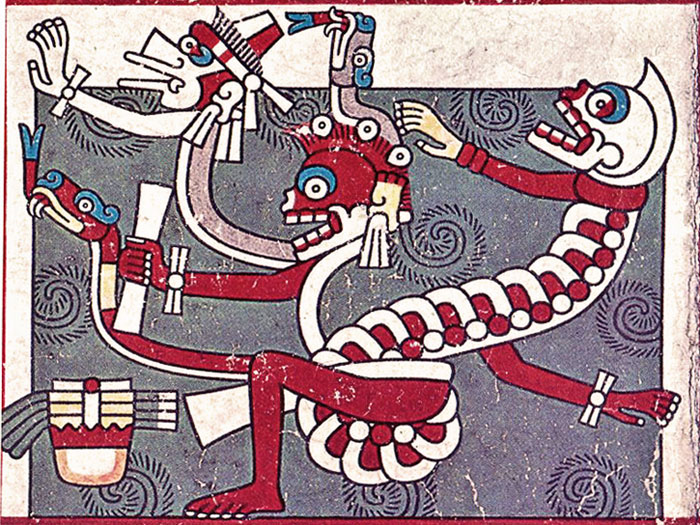
in another Post (1) several references note that the “seat of the soul” for the Aztecs was the intestines and as such gastrointestinal illnesses and conditions, specifically trip ida, are synonymous with another condition called susto (2). My research does not indicate this though.
- Empacho and Tripa Ida
- a condition caused by fright of some kind that forces the soul from the body and which can be the impetus for other illnesses including both metal (anxiety, depression) and physical (often digestive but includes physical weakness and wasting). See also Glossary of Terms used in Herbal Medicine. and What is Curanderismo? for more on susto.
For the Mexica, the human body mirrored the cosmos, both being composed of heavy and light substances. The light substance within humans was divine and gave rise to the various souls, each possessing individuality and consciousness. Because of this, souls could sometimes be in conflict, and disharmony among them could bring about illness or even death.
The heavy, material part of the body was sustained by the bounty of the earth, yet destined to decay over time. Ultimately, it was offered back to the earth goddess, signifying a reciprocal relationship between humans and the divine. This cycle of return embodied the central religious principle of reciprocity between people and gods.
Each individual contained multiple souls or soul-like entities, each with distinct qualities, vulnerabilities, and roles. Importantly, these souls possessed free will. Their balance and cooperation determined the individual’s health and well-being.
The Heart and the Teyolía
The heart was regarded as the vital centre of consciousness, while the liver stored blood and the gall bladder housed anger. Of the various souls, the most essential was the teyolía, or “heart soul,” of divine origin. Though it shared its name with the physical organ (yóllotl), the teyolía was considered a spiritual essence that entered the body before birth and remained until death.
The teyolía was layered with divine levels, and its primary functions were to animate the body, govern thought, and regulate emotions. It also coordinated the activity of the other souls. Illness or madness could arise when moral failings disrupted its harmony. Like the gods themselves, the teyolía could divide or transform, embodying the capacity for multiplicity seen in Mesoamerican deities.
The Tonalli
Also divine in nature, the tonalli was associated with the head and infused into the child during a birth ritual. During this ceremony, sunlight reflected in water was presented to the newborn, bestowing upon them qualities of the god-day under which they were born. This god-day became part of the child’s name and identity.(1)
- This similarity to the Christian baptism rites must not have sat well with the Spaniards. They were already mightily offended by the Tzoalli rituals and its similarity to the Catholic Holy Communion ritual. See Amaranth and the Tzoalli Heresy for more on this.
Unlike the teyolía, the tonalli could leave the body—during sleep, sexual intercourse, or in moments of shock. If lost, it risked capture by the earth gods, resulting in grave illness or death. An individual’s responsibility was to preserve their tonalli through upright, compassionate, and disciplined behaviour.
The Ihíyotl
Housed in the liver, the ihíyotl governed desires, appetites, lust, greed, and courage. Like the tonalli, it entered through the ritual bathing of newborns, which also infused parts of the heart and liver. Portions of this soul could emanate outward, producing vigour, alleviating pain, or stirring courage. Shamans, for example, were believed to be able project their ihíyotl during dreams and affect others.
The ihíyotl’s health depended on emotional moderation, proper sexual conduct, and balanced relations with other souls. Excesses, particularly sexual transgressions (1), damaged it and could cause harm not only to the individual but also to their family, community, crops, and environment.
- Xochipilli was considered to be the force that punished one for their sexual excesses
Balance of Hot and Cold
Health depended on the equilibrium of complementary yet opposing forces, often described as hot and cold. These were not literal temperatures but symbolic qualities. For instance, anger was thought to concentrate heat in the body’s core while cold lingered at its surface, while shame brought heat to the skin and cold within. Such imbalances could cause the loss of vital substances or allow the invasion by harmful invisible beings, including “airs” from the underworld. Nahua medicine relied heavily on restoring this balance, classifying foods and remedies as hot or cold to counteract illness.
Sacrifice and Reciprocity
Central to Mexica religion was the obligation of humans to repay the gods for creating and sustaining life. Some sacrificial victims were called nextlahualtin (“payments”), symbolizing their role as offerings, while others were teteo imixiptlahuan (“images of the gods”) (1)(2)(3)(4)(5), whose bodies were ritually inhabited by divine beings.
For more on the teteo imixiptlahuan (ixiptla, teoixpitla) see also
- Teotl. Gods? Forces of Nature?
- Xochipilli. The Prince of Flowers
- Xochipilli : Hymn to Xochipilli
- Xochipilli : Intoxicating Scent.
- Xochipilli. The Symbolism of Enrique Vela
Death and the Afterlife
Death itself was understood as repayment to the gods for the gift of life. Each soul followed its own destiny: the ihíyotl might roam the earth as a dangerous yohualehécatl (“night air”), while the teyolía continued its divine duties beyond death. Since humans were created to support the gods through work, the teyolía remained bound to this purpose even after the body’s end.
References
- Burkhart, Louise M; (1996) Holy Wednesday: A Nahua Drama from Early Colonial Mexico (Philadelphia: University of Pennsylvania Press, 1996), 190.
- “Leyenda de los soles” 1945 Leyenda de los soles. In Códice Chimalpopoca, translated by Primo Feliciano Velázquez, pp. 119–164. Instituto de Investigaciones Históricas, Universidad Nacional Autónoma de México, Mexico City.
- López Austin, Alfredo. The Human Body and Ideology. Thelma Ortiz de Montellano and Bernard R. Ortiz de Montellano, trans. 2 vols. Salt Lake City: University of Utah Press, 1988.
- López Austin, Alfredo (2017) The Human Body in the Mexica Worldview : The Oxford Handbook of the Aztecs Edited by Deborah L. Nichols and Enrique Rodríguez-Alegría : Oxford University Press
- Montoya Briones, Jose de Jesus (1964). Atla: Etnografia de un Pueblo Nahuatl. Mexico City: Mexico City: INAH. p. 165.
- Sullivan, Thelma & Knab, T.J. (1994), A Scattering of Jades: Stories, Poems, and Prayers of the Aztecs, eds. 208.
 Masa Americana