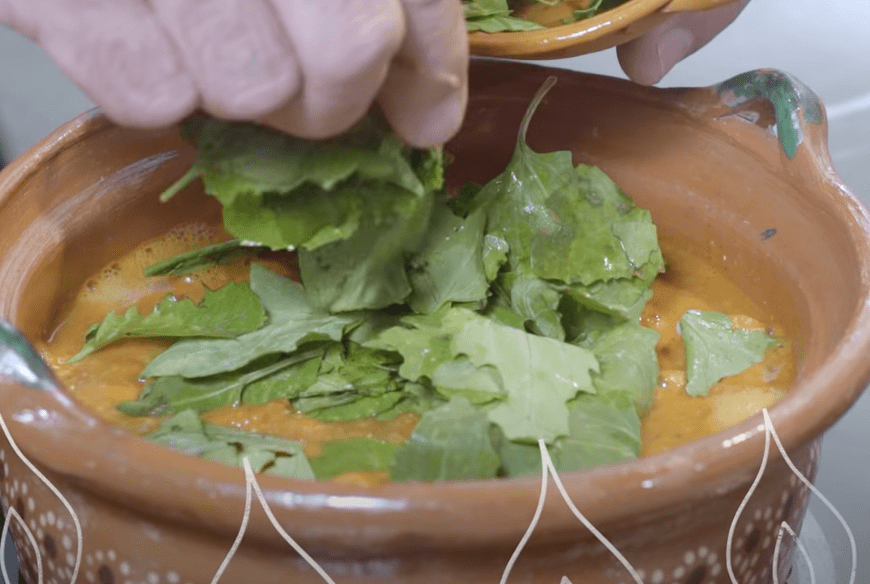
Prehispanic Veganismo – The Tlaltequeada

A tlaltequeada is a kind of vegetable based rissole (1) typically made with vegetables, fruits, flowers and seeds. It is the perfect example of a quilitl (quelite) based dish and it could be argued that it is representative of a vegetable based cuisine as it would have been practised by prehispanic Mesoamericans. rissoles are what an Australian might call meat patties that include some grated … Continue reading Prehispanic Veganismo – The Tlaltequeada

Quelite : Chipilin : Crotalaria longirostrata

also called : chepil, chepilin, cascabel de vibora, chapilin, chinchín de zope, chipilín de zope, chipilín de caballo, chipilino, garbancillo, parrajachel, tcap-in, tronador, longbeak rattlebox. Some 600 or more species of Crotalaria are described worldwide, mostly from the tropics with at least 500 species known from Africa: 19 species are native to Australia (Ryan etal 2011). The common name rattlepod or rattlebox is derived from … Continue reading Quelite : Chipilin : Crotalaria longirostrata

Lactucarium : The Journey Continues.

My initial foray into the production of lactucarium was hampered by one main issue, the lack of harvestable material. This has changed this season (Spring 2021). I recently moved into a new house. When I did a walk through inspection about 6 weeks ago the lawns were all mowed and the gardens manicured as you can see in the photo below. The date we moved … Continue reading Lactucarium : The Journey Continues.

Recipe : Alegrias de Amaranto : Amaranth Joys.

Amaranth was an important grain in Mesoamerica. Known to the Aztecs as huauhtli they are believed to have dedicated more than 5000 hectares of land to its growth and produced between 15 and 20 tons of grain per year (1). This is just the Aztecs. Amaranth was in high demand as a tribute and annually 20 provinces supplied amaranth to Tenochtitlan as part of their … Continue reading Recipe : Alegrias de Amaranto : Amaranth Joys.

31 Alimentos que México dio al mundo : 31 foods that Mexico gave to the World

Mexico (and the Americas in general) has given much to the worlds food larder. We are familiar with many of these foods even though we might not know where exactly the came from (1). We can thank the Americas for staple foods such as corn, potatoes, tomatoes, beans (2), squashes, chiles, avocados, the turkey, vanilla and cacao (3) as well as the highly nutritious seeds … Continue reading 31 Alimentos que México dio al mundo : 31 foods that Mexico gave to the World

Porophyllums : Medicinal Utility : A Recap

The infusions of some species of Porophyllum are used in traditional medicine because of activity against cramps and venereal diseases, as well as for their antispasmodic, antibacterial, anti-inflammatory, antifungal, and insecticide properties. The terpenoid compounds of the Porophyllum genus have been of great interest due to the large number of biological activities they present. In vitro and in vivo studies performed with the purified extracts … Continue reading Porophyllums : Medicinal Utility : A Recap

Porophyllum leucospermum

P.leucospermum is considered to be a synonym for Porophyllum gracile (1) which is also known as “slender poreleaf”. See Post Porophyllum gracile : Deer Weed for further information on P.gracile. Other synonyms for P.gracile include Porophyllum caesium Greene Porophyllum cedrense Rose & Standl. ex Rydb. Porophyllum confertum Greene Porophyllum confertum var. ochroleucum (Rydb.) I.M. Johnst. Porophyllum junciforme Greene Porophyllum leucospermum Greene Porophyllum nodosum M. E. … Continue reading Porophyllum leucospermum

Essential Oil Properties

In many of the medicinal descriptions of plants I note the chemical constituents of plants. For those who know of such things these chemicals will indicate the healing potential of the plant. Essential oils can be drawn from a plant in a number of ways. The two most important being a steam extraction of the oil or the oils that are extracted via alcohol when … Continue reading Essential Oil Properties