






Xochipilli : Is it a Dahlia?
I think we may be overlooking the obvious. In my continuing quest to understand Xochipilli, both in spirit and in form, I am drawn to the floral imagery portrayed on the idol. I am unconvinced of the current paradigm which would have me believe that all of these plants are intoxicants designated for shamanic usage. Wasson, to fit a theory, has perhaps projected his own … Continue reading Xochipilli : Is it a Dahlia?


Recipe : Mole Cookies (1)
In Australia we call them biscuits I have previously waxed lyrical on the subject of mole (1) and even queried the legitimacy of pre-made mole (2). One thing I have not done however is use mole in a sweet dish. I do make a chocolate, cherry and ancho chile biscotti which tends to be well received so it wasn’t a stretch to use mole instead. … Continue reading Recipe : Mole Cookies (1)

Chamoy
My first introduction to chamoy was through FOMEX (1). It was a sweltering Australian summers day and I was attending a taquiza (2) for FOMEX members and their family and friends. I joined FOMEX after visiting Mexico because I wanted to expose myself to the cooking of a culture as it appears in its home kitchens. I also wanted to test my cooking on the … Continue reading Chamoy

Horchata
The drink horchata is another example of Moorish influences in the cuisines of México. The drink as it it was historically known dates back to ancient Rome where it was a medicinal drink made from barley. Etymologically this is where the word horchata was born; from the roman “hordeum” (barley) and “hordeata” (drink made from/with barley). As the drink travelled the world, borne aloft by … Continue reading Horchata

Marinades : Recado Rojo
Typically when I think of a marinade I think of a liquid that something (usually meat) is immersed in so as to give it flavour or, in the case of tougher cuts of meat, to tenderise it. You marinate the meat by soaking it in the marinade. The word marinade hearks back to the use of salted water as a brining/pickling liquid (1). Generally anything … Continue reading Marinades : Recado Rojo

All Tequila is Mezcal BUT not all Mezcal is Tequila.
This is something you may hear regarding the differences between tequila and mezcal. Previously this little dicho (or saying) did bear some relevance as both tequila and mezcals are made from the maguey (or agave). The main difference was that mezcal could be made from any number of agaves (1) whilst tequila could be made from only one variety (2). Tequila is protected by both … Continue reading All Tequila is Mezcal BUT not all Mezcal is Tequila.

Poetic Language of the Maguey.
There are many rituals and traditions that surround the imbibing of the life blood of the agave (1) and there is a deep poetry in the language used to describe its consumption. In some rituals of agricultural abundance pulque was poured onto the ground whilst planting the corn to increase the fertility of the earth and encourage the corn to grow. When drinking pulque the … Continue reading Poetic Language of the Maguey.

Edible Insects : Hormiga de miel : Honeypot ants
Honey ants, sometimes called honeypot ants, are found in a few arid areas of the world, including Mexico and Australia. “Honeypot ant” is a common name for the many species of ant with workers that store honey in their abdomen. Honey pot ants are not a separate ant species, but rather a specialised role taken by designated worker ants of various different species. These individuals, … Continue reading Edible Insects : Hormiga de miel : Honeypot ants

Xochipilli : Hymn to Xochipilli
Lyric wordplay is a rich cultural tradition in México. In the days of the Aztec poetry and its performance was known as in xochitl in cuicatl (1) (“flower and song” or songs of flowers) and those adept in it were known as xochitlahtoanime (flowerspeakers) or cuicapicque (songmakers). Flowers contained deep symbolic meaning in Aztec philosophy and the very structure of the Universe itself was modelled … Continue reading Xochipilli : Hymn to Xochipilli
Edible Insects : Escamoles
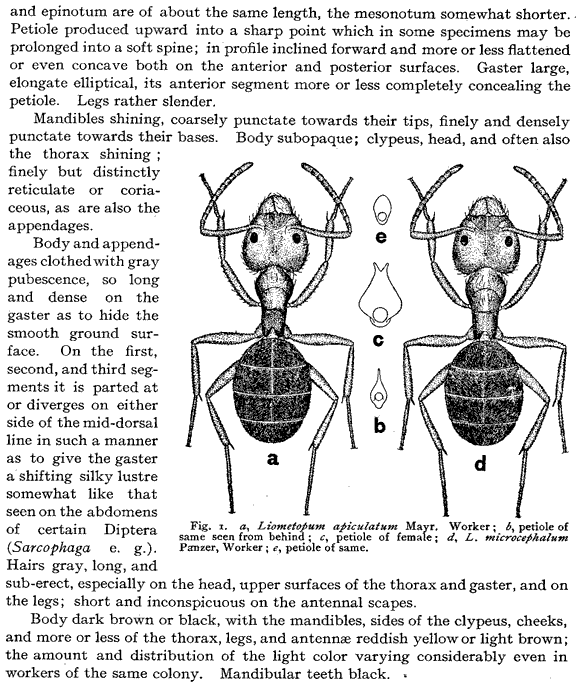
Escamoles are the larvae and pupae of Liometopum apiculatum (1) ants, a species of ant in the subfamily Dolichoderinae. originally named Formica masonium Also called Velvety tree ants, la hormiga pedorra (the farting ant)(1), hormiga güijera, chiquereis, chiquereyes, cuijes, güijes, hormiga de hueva, maicitos, tecates, teclates, tetlames, tetlas. so named because of the particular odour of the ants nests and the scent of the crushed … Continue reading Edible Insects : Escamoles
 Masa Americana