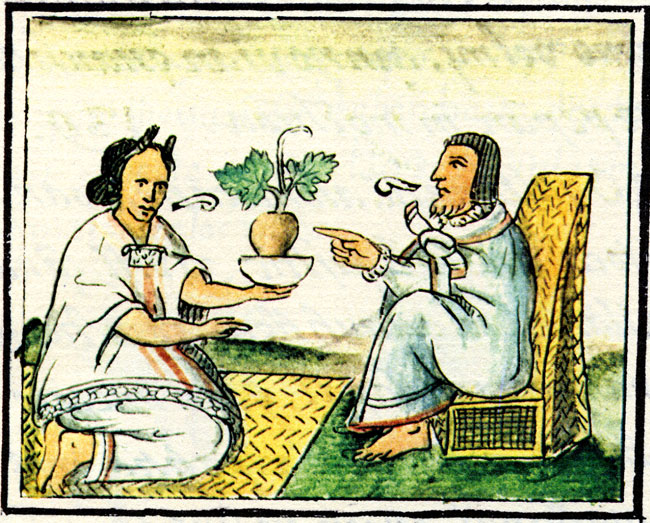
Papaloquelite : It’s History in Text

The first written references to papaloquelite (papaloquilitl) appear in the Libellus de Medicinalibus Indorum Herbis (“Little Book of the Medicinal Herbs of the Indians”) or more commonly the Codex de la Cruz-Badiano (Badianus Manuscript) . This text was written by Martín de la Cruz in the Colegio de Santa Cruz de Tlatelolco (1) in 1552 and then translated into Latin by Juan Badiano. The book … Continue reading Papaloquelite : It’s History in Text

Papalo, Guerrero, and the Cemita Poblana.

Papalo is a herb that falls under the designation of “quelite” (1). Quelites are (usually) wild herbs that are allowed to grow if they spontaneously sprout within the milpa or are collected from the wild. The term quelite is not limited to leafy herbs but also encompasses the flowers (2), roots (3), vines, stems (4) and seeds (5) of various plants (including trees)(6). Some quelites … Continue reading Papalo, Guerrero, and the Cemita Poblana.

Books along the way

As a chef I have amassed a collection of books regarding the cuisines of many cultures. The largest section of my collection is by far the books on México (and México adjacent) cuisine. This is a small journey through the library of my mind. This was the book that fundamentally changed my understanding of Mexican cuisine and cookery. This book also introduced me to the … Continue reading Books along the way

Cooking Technique : Acitronar (and by default the Biznaga and Acitrón)

acitronar (first-person singular present acitrono, first-person singular preterite acitroné, past participle acitronado) This technique is not solely a phenomenon of México. In French cuisine the technique known as “sweating” is very similar in nature to acitronar Sweating is the process of releasing flavours with moisture and low temperatures. It is a technique that uses a gentle heat to soften vegetables and gently draw out their … Continue reading Cooking Technique : Acitronar (and by default the Biznaga and Acitrón)

Quelite : Chivatitos

(also called) : chivatitos , chivitos , chivatos, lengua de pájaro (birds tongue), lengüitas, Hierba de San Nicolas, barbas de San Nicolas, berros, excacahue, señorita, barba de chivo, tsikuarini, quelite poblano, xubatoti (Matlatzinca), Rock purslane, Red maids, Fringed Red maids Variously identified as Calandrinia ciliata (Linares etal 2017) (syn Calandrinia caulescens) (Yanovsky 1936) Calandrinia micrantha (Castillo-Juárez etal 2009) Calandrinia is a large genus of flowering … Continue reading Quelite : Chivatitos

Quelite : Tequelite

Also known as Peperomia maculosa : tequelite, tequelite macho (1), najashuio macho, juksasan, cunsasan grande, oreja de burro “donkey ear” (Coatepec, Altotonga, Coscomatepec.), cuantepeneni (Altotonga), cilantro de monte and cilantro macho (Coatepec, Xico) P.peltilimba : Nacastequilit, tequelite, tequelite hembra (1),Tequelite de panixkaka (Cuetzalan, Zoquiapan, Tuzamapan, Huehuetla and Tlalauquitepec, in the northern highlands of Puebla (Rodríguez & al., 2010) tepoquelite, cilantro de monte, cilantro cimarrón, cilantro … Continue reading Quelite : Tequelite

Xocoyoli : The Sour Quelite

As a child one of my first plant memories involves what we called “sour grass”. This is a plant in the Oxalis family (Oxalis pres-carpae) that has four leaf clover like leaves, bright yellow flowers and long juicy stems. The stems (or peduncles) would be chewed like a farmer chews a haystalk as we walked or played. It was often a challenge to see who … Continue reading Xocoyoli : The Sour Quelite

Estrella del Mar (Ulam Raja) : Cosmos caudatus

Cosmos caudatus Synonyms Common Names Sometimes called “Spanish needles” although this name is typically used for the (closely related) herb Bidens pilosa. Some Common Names in Asian countries Indonesia: kenikir (Java), randa midang (West Java). Philippines: cosmos (Tagalog), turay-turay (Bisaya), onwad (Ifugao). Thailand: daoruang-phama (Bangkok), khamhae (northern). Malaysia: ulam raja, hulam raja, pelampong. In Malay culture, the word “ulam” refers to certain plants found locally … Continue reading Estrella del Mar (Ulam Raja) : Cosmos caudatus