
The writing system used by the Aztec at the time the Spanish arrived was not the same as the one we use today, the one I’m using now. Instead of using an alphabetic, syllabic text they essentially drew comic books. I do not mean to disparage them in any way by saying this and, when we eventually get to my exploration of botanical terminology and nomenclature as used by the Aztec, you’ll only find me being totally impressed by its precision and sophistication.
To the subject at hand, my sidetrack..
In my Post on the Flor de izote I go a little into the depiction of this plant (1) in various codices. One of these codices is the Codex Quetzalecatzin (2)
- the Yucca species.
- also known as the Mapa de Ecatepec-Huitziltepec, the Codex Ehecatepec and Huitziltepec, or the Charles Ratton Codex
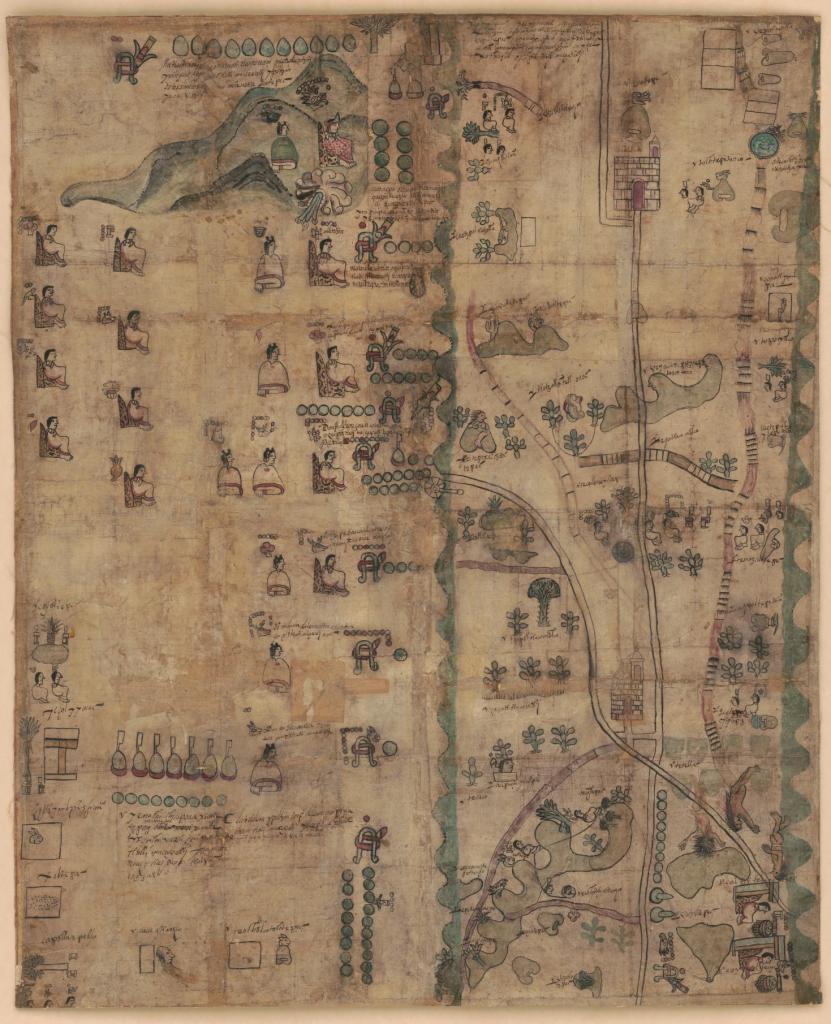
This extremely rare example of a coloured Mesoamerican indigenous manuscript dates from between 1570 and 1595 and relates the extent of land ownership and properties of a family line known as “de Leon,” most of the members of which are depicted on the manuscript. This manuscript illustrates the family’s genealogy and their descent from Lord-11 Quetzalecatzin, who in 1480, was the major political leader of the region.
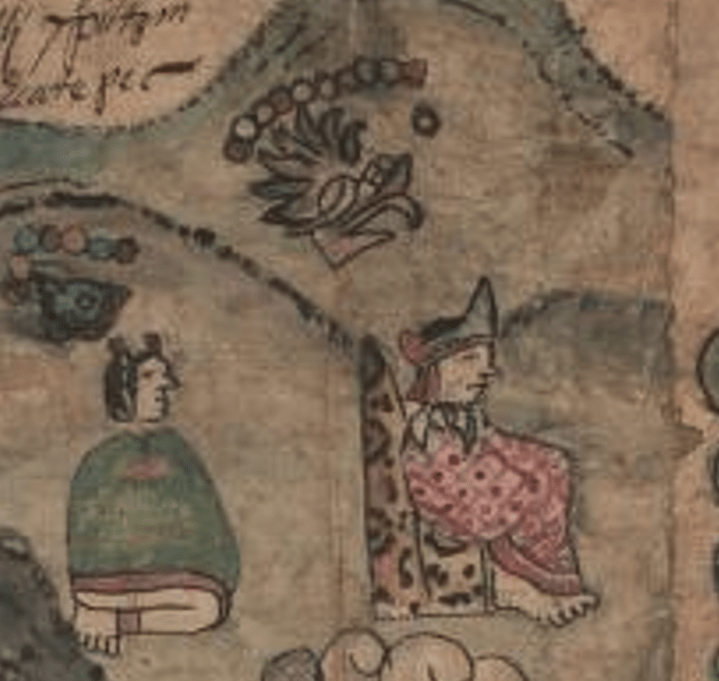
Lord-11 Quetzalecatzin as depicted (top of image, just left of centre)
The codex shows the de Leon family presiding over a large region of territory that extends from slightly north of Mexico City, to just south of Puebla. This is a large piece of real estate. It also goes to show that these maps were representative of an area and would have been useless for land based navigation (as it is practised today)
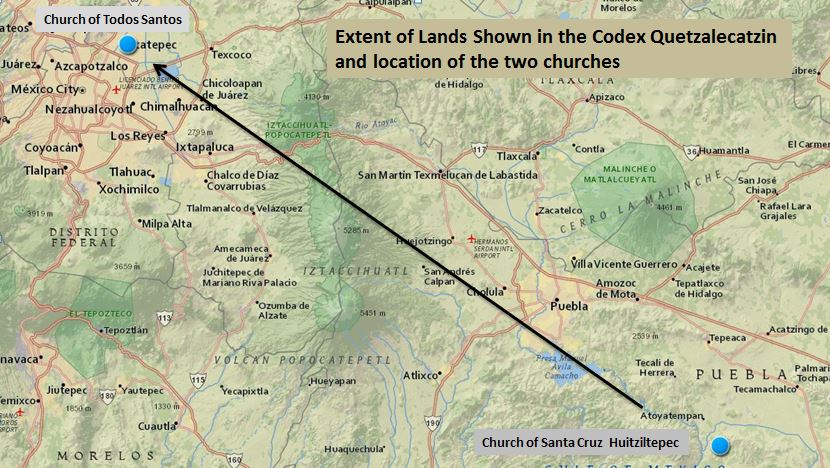
Extent of the Lands shown in the Codex Quetzalecatzin. Map created by John Hessler
Iczotl Iyacac, the location being discussed is to be found in the bottom left corner of the codex.
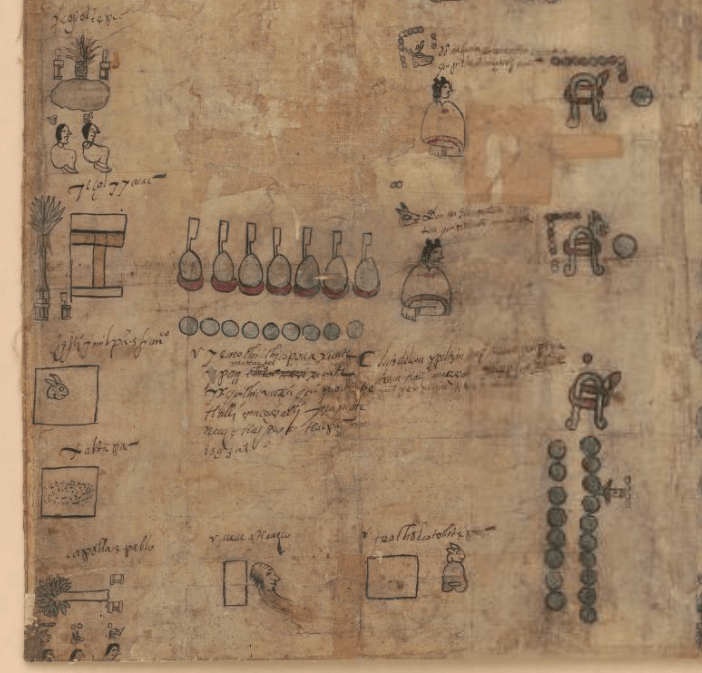
There are two other locations noted on the map that contain vegetation as part of their nomenclature.
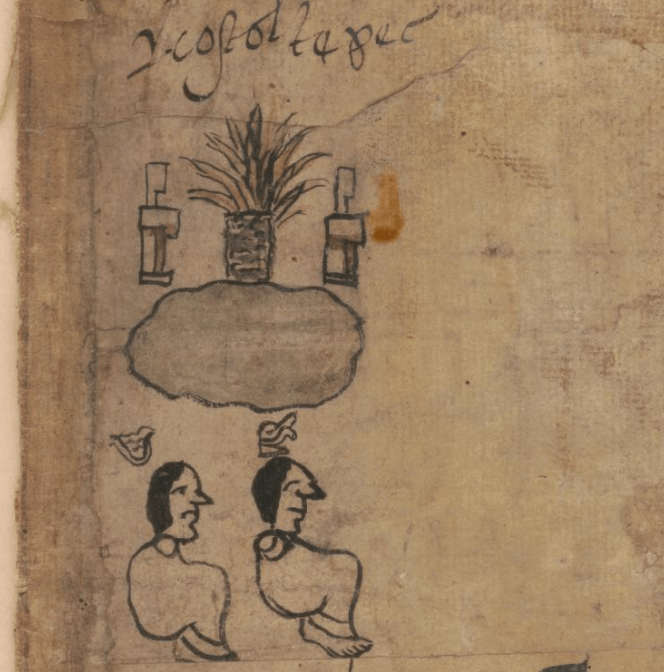
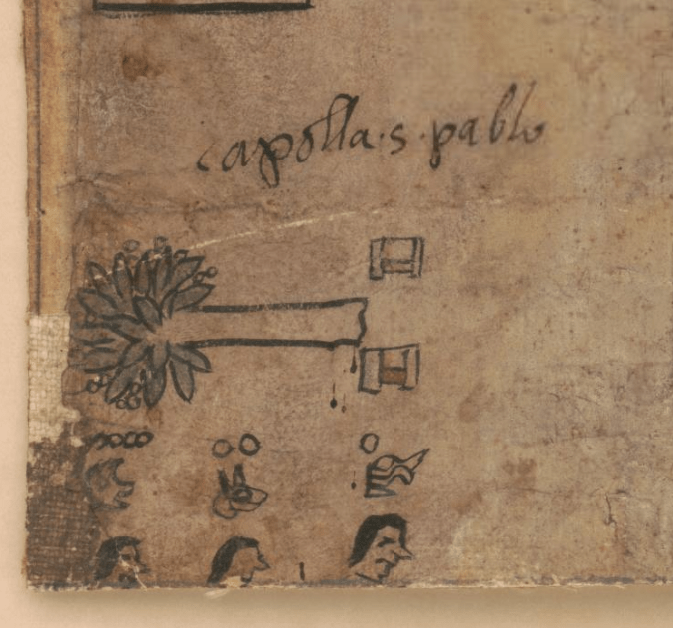
On this map is depicted the location of Iczotl Iyacac, the etymology of translation of which is said to be…
This simplex glyph of an iczotl bush stands for the place name Iczotl Iyacac (tentatively translated as “Point of the Yucca”).
Which is derived from
- iczo(tl), a type of yucca.
- yacatl, nose, point, peak.
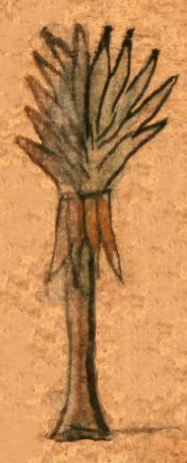
The iczotl
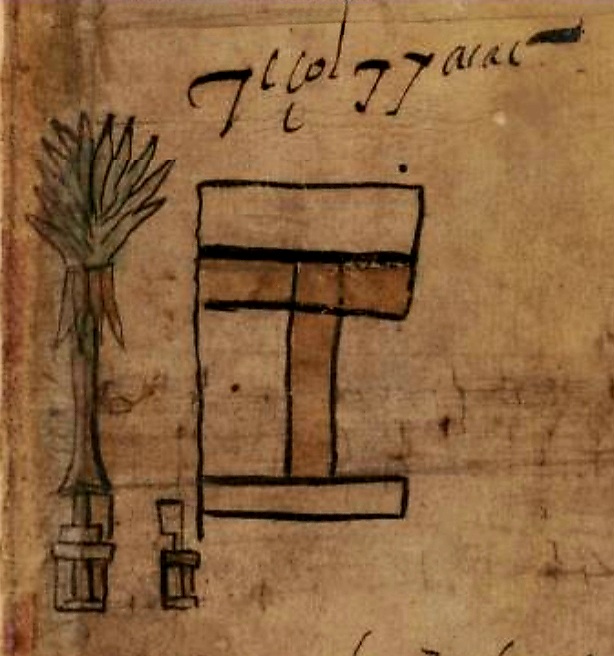
The Iczotl Iyacac.
Now this is where my confusion arose.
In the image above, being the toponymic glyph (1) of Iczotl Iyacac. The Iczotl is fairly straightforward as it translates directly to the name of a type of tree/plant/shrub.
- Toponymic glyph are “hieroglyphs” that act as proper nouns for locations. They are symbolic, pictorial characters used in ancient Mesoamerican writing systems – notably Aztec (Nahuatl) and Maya – to represent a specific place name. These glyphs often directly represent landscape features, waterways, or significant structures (such as mountains, temples, or trees) to identify towns, cities, or regions. These glyphs are highly descriptive and visual, representing the landscape directly to tell the story of a location. They served as a geographical notation system in inscriptional records, manuscripts, and maps, allowing researchers to track historical geography, ethnic movements, and regional political hierarchies
The Iyacac however is said to relate to yacatl or nose (nariz) and, for the life of me, I can find no nasal related imagery in the glyph for Iczotl Iyacac.
This is how you might find the yaca(tl) glyph presented as part of a geographical feature naming the location of a region.
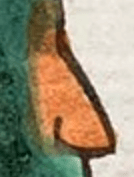
yaca(tl), nose, peak, or the point of something. Additional Scholars’ Interpretations: nose, point, peak, ridge
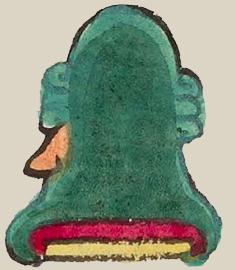
compound glyph for the place name Tepeyacac
Relevant Nahuatl Dictionary Word(s):
- tepe(tl), hill or mountain
- yacat(l), nose, point, peak
- -yacac (locative suffix), on the rim of
Additional Scholars’ Interpretations : “At the Point of the Mountain”
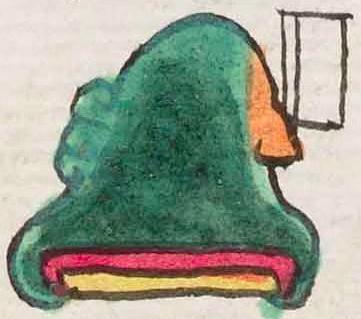
I did previously mention that the Aztec language (Nahuatl) was not syllabic. This is not entirely correct as we can see in the image of the toponym for Tlayacapan.
compound glyph for the place name Tlayacapan
Relevant Nahuatl Dictionary Word(s):
- tla- (indefinite prefix)
- yaca(tl), nose, point, ridge
- pan(itl), flag : -pan (locative suffix)
These are all strictly geographical and describe a peak, point or prominence on a mountain or other rocky feature on the landscape.
This is not really relevant here as we are describing Iczotl Ayacac as being at the peak of – point of the iczotl. I still see no nose……
A non geographical instance, Cuezcomatl Iyacac
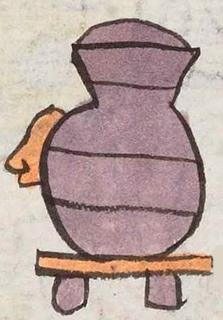
Cuezcoma(tl), maize storage container
yaca(tl), nose
i- (third person singular possessive pronoun)
-c (locative suffix)
Additional Scholars’ Interpretations: “In the Beginning of the Granaries” (Berdan and Anawalt, 1992)
This make sense. A cuezcomatl (cuexcomate) is a largish grain storage bin and they would have stood in large groups, if not fields, due to the agricultural prowess of the mesoamericans and due to the rapacious tribute demands of the Mexica (Birx 2006).
William T. Sanders looked at maize yields for the highly productive chinampa agriculture in the Valley of Mexico. These chinampas covered an area roughly 9,500 hectares (23,500 acres) in the lakes of Xochimilco and Chalco alone and they ranged in production (of maize) from about 2400 kg/ha (22,800 tons) on the low end, but with a few reaching 6300 kg/ha (59,850 tons) on the high end (Sanders 1957). Most chinampas yields fell in the range of 3000-4000 kg/ha. This area alone could produce an annual surplus of approximately 16,500 metric tons of corn.(Martínez Ruiz 2014)
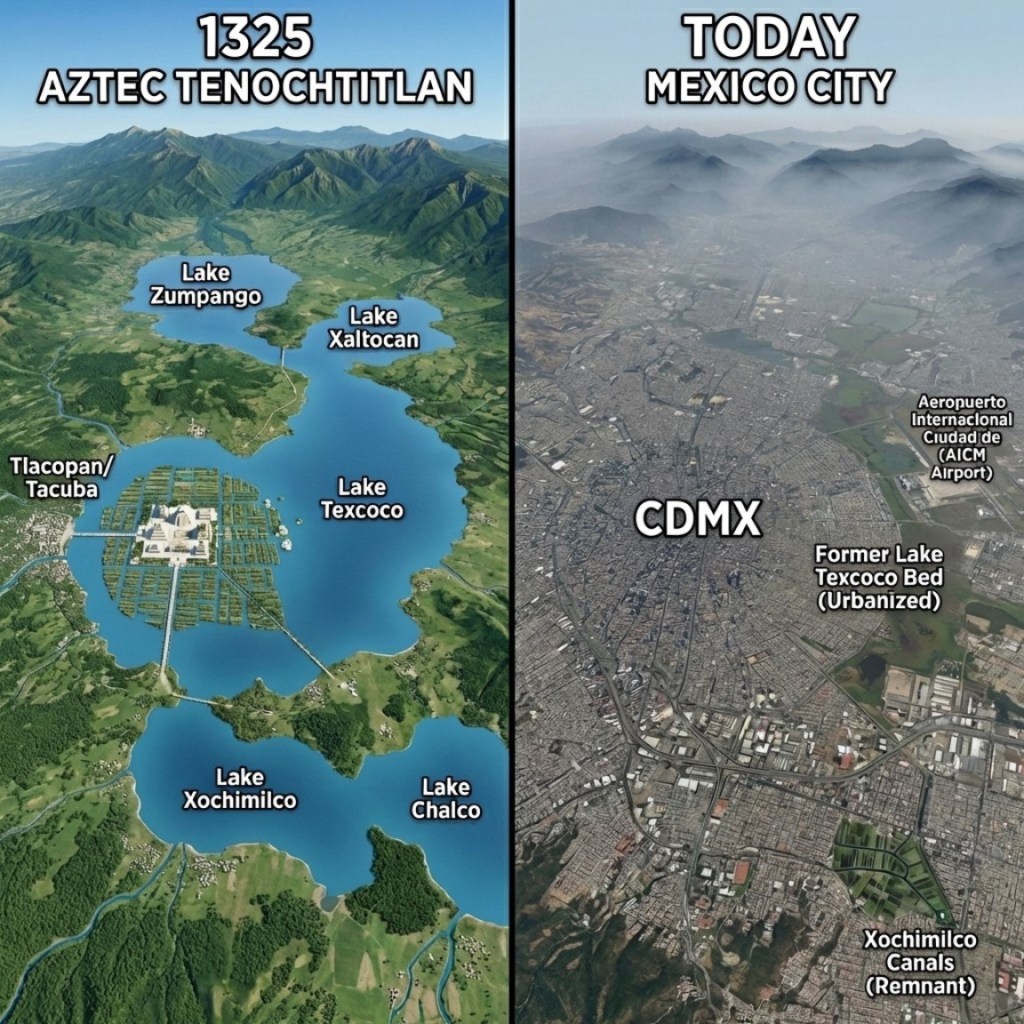
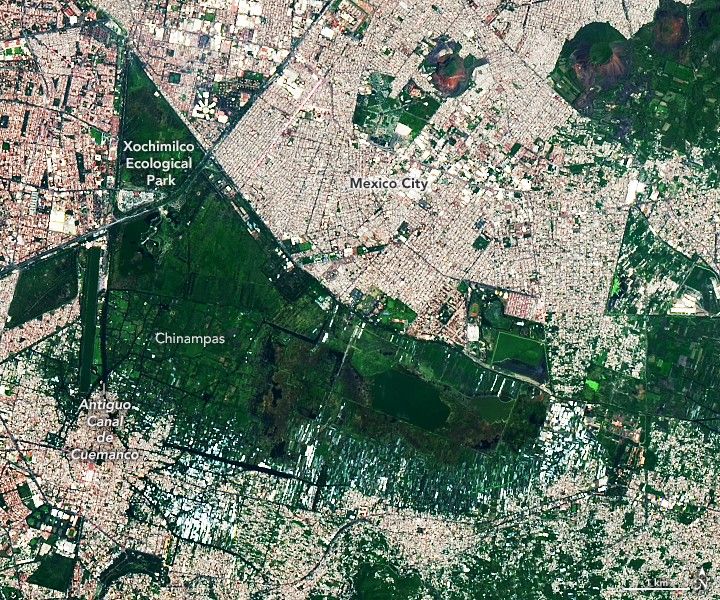
Chinampa agriculture was primarily located in the areas of Lake Xochimilco, Lake Chalco and Lake Xaltocan. Only the area around Xochimilco continues to grow using this method.
Records from the reign of Montezuma II indicate that 7,000 tons of maize (6,363 metric tons) and 4,000 tons of beans (3,636 metric tons) and other consumables (1) were transported annually into the capital (likely as a result of tribute payments demanded by the Mexica).
- The Aztec Empire demanded massive quantities of amaranth—known to them as huauhtli—as tribute, with estimates suggesting that more than 20,000 tons of amaranth grain were sent annually to Tenochtitlan from 17 provinces and they maintained 18 imperial granaries that were filled with up to 10,000 bushels of grain each. (For wheat, one bushel equals 60 pounds of wheat or approximately one million wheat kernels. (Marx 1977) (Nielsen 1996). While there is no universally standardized bushel weight for amaranth in the same way there is for wheat or corn, 56 lbs is sometimes used for yield calculations. However, high-quality, dry, and clean amaranth is dense, often landing in the 60–65 lb per bushel range. That would put 10,000 bushels at a little over 27,215kg (27 tons) of amaranth in EACH granary (for a total of 489,870kg – which is a far larger number that that provided by the authors above). Someone’s math is out. Regardless of this it is still a huge amount of grain.
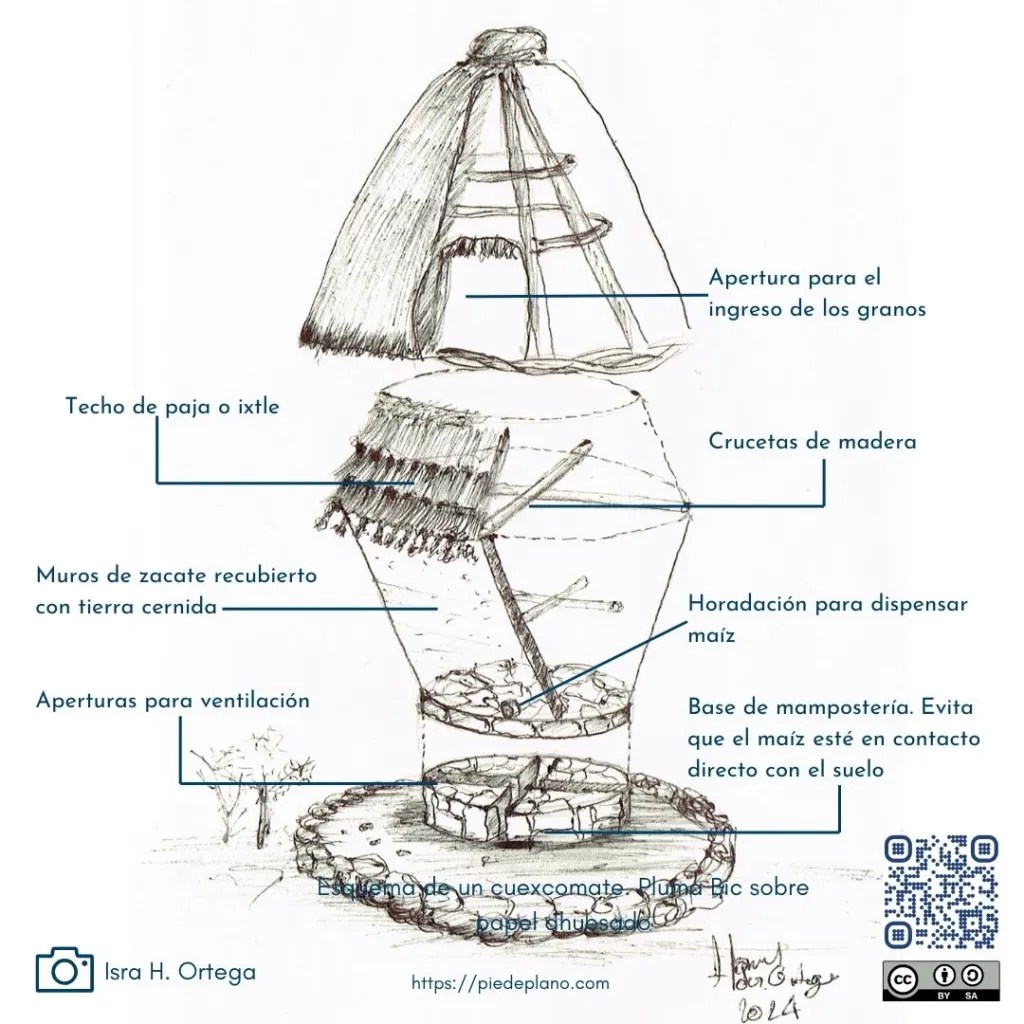
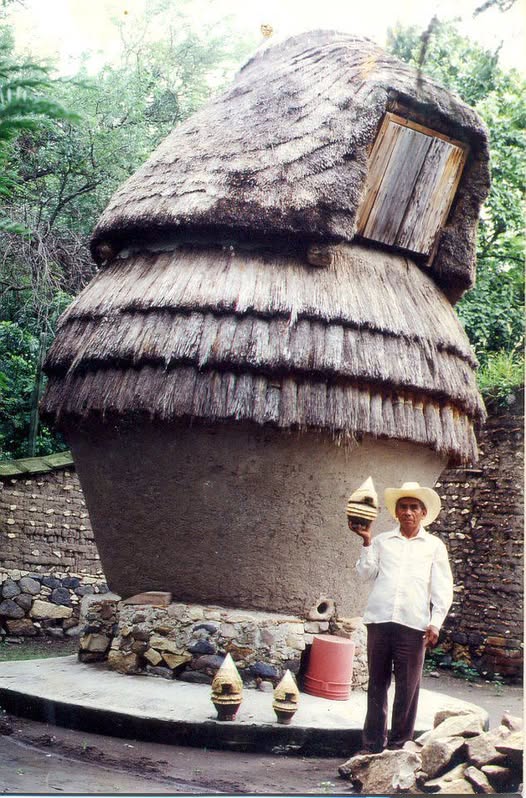
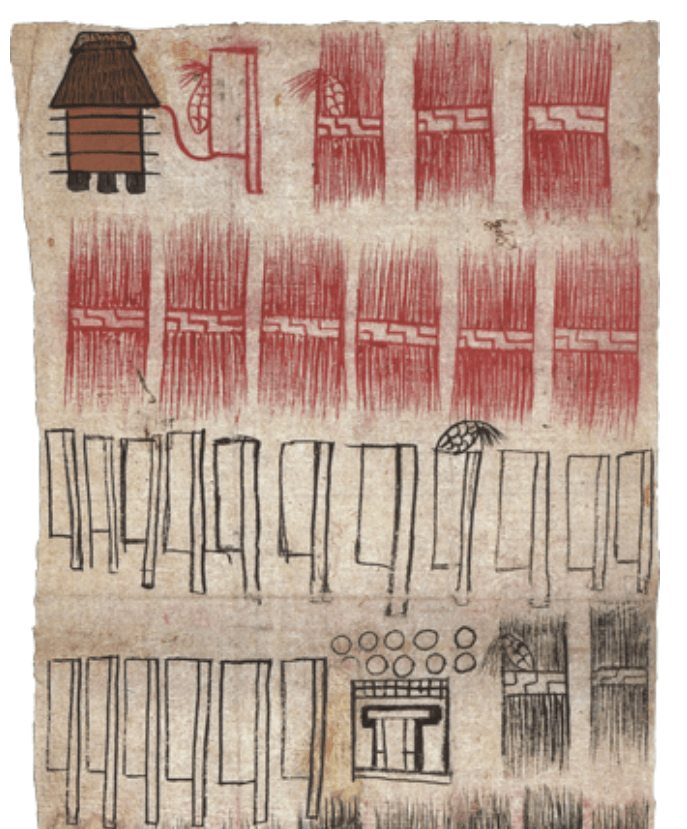
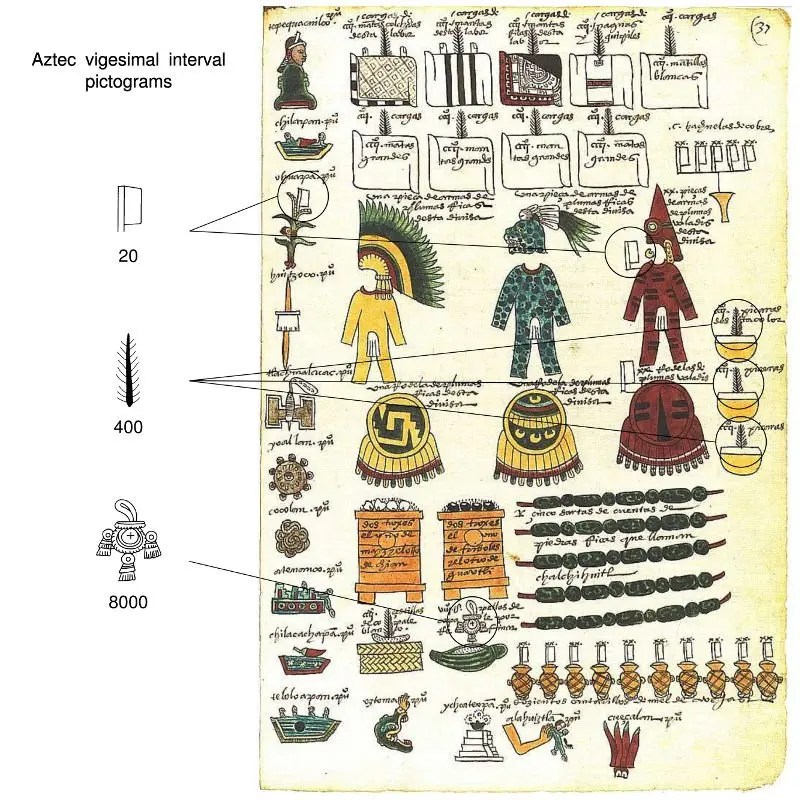
Huexotzinco Codex, 1531 : Plate 7, shows some agricultural tributes. In the upper left corner of the image we see a representation of a cuezcomatl, grain storage facility. The flag and the line may indicated that twenty granaries full of maize may have been required. Were these twenty granaries what was contained in the additional red bundles? What about the black bundles (400 bushels per – at 56lb per bushel) and the flags (20 bushels per). All of these counters show a corn cob, indicating that they all involve a number of bushels of maize (and a huge amount of grain requiring storage).
This is just to say that there may have been large fields of these granary bins and a map needs to determine their “point”.,
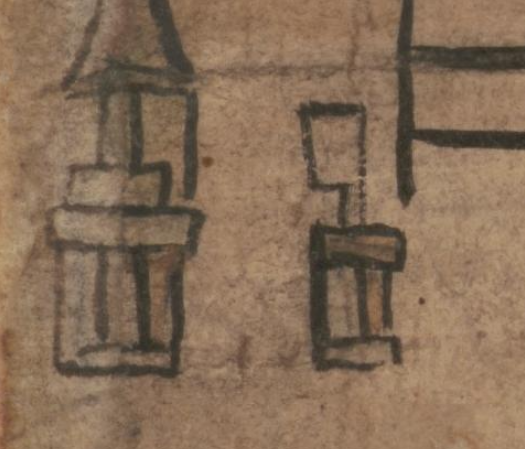
The only other images I can see related to this name are calli (house – more or less) or maybe pantli (flag) (on the little house at the bottom of the image? or is that an American style mailbox? You know, the ones with the little flag?)
Calli
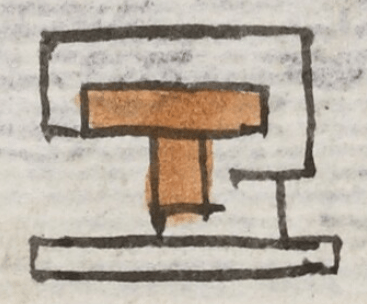
Codex Mendoza, folio 10 recto

Single-page codex, Archivo General de la Nación, México, Ramo de Tierras, vol. 1735, exp. 2, fol. 109
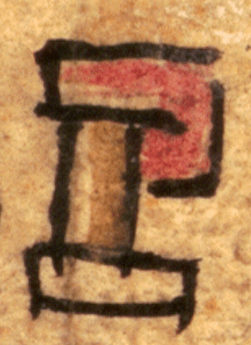
Codex Quetzalecatzin, aka Mapa de Ecatepec-Huitziltepec
The houses can get pretty schmancy
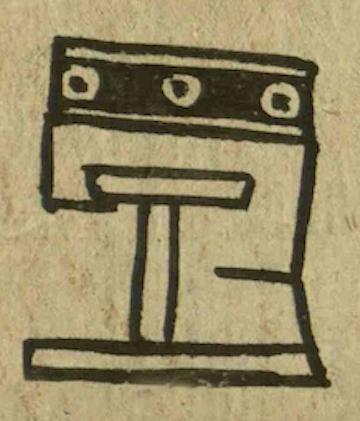
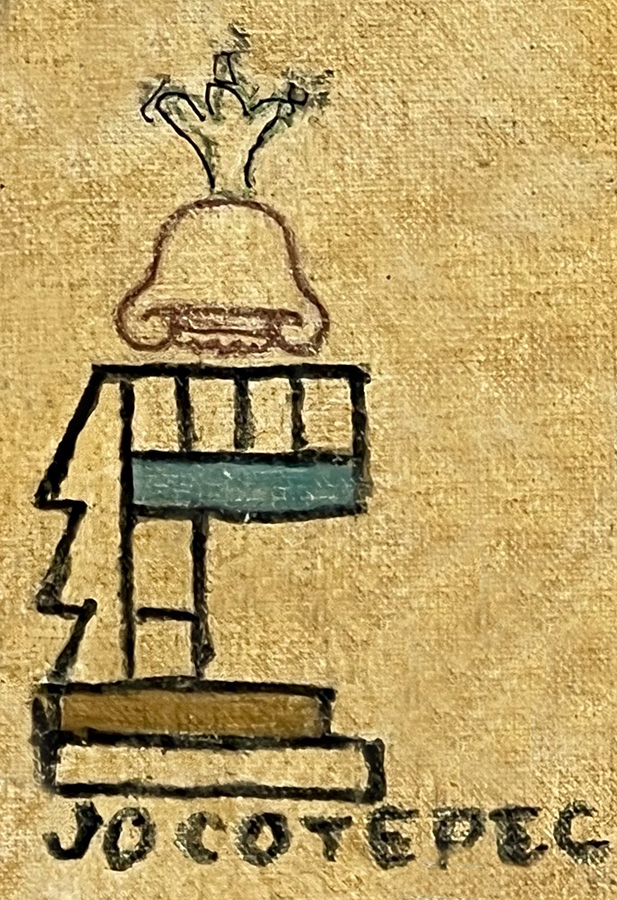
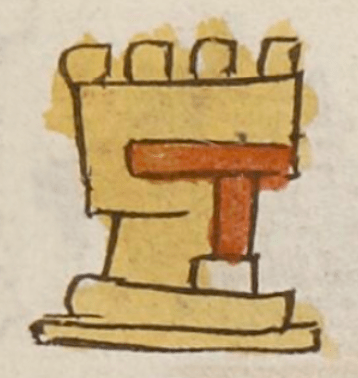
- Tecpancal(li), royal palace
- Jocotepec (Xocotepec)
- Cal(li), house/building, also day sign (this one has crenellations or ramparts (tenantli) on the roof)
Pantli (Panitl) : flag, banner

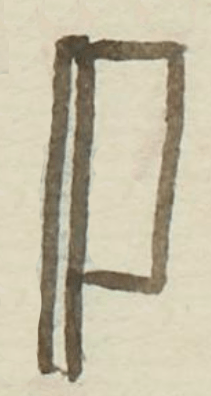
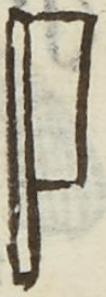
The flag also denotes 20 in the Aztec numerical system.
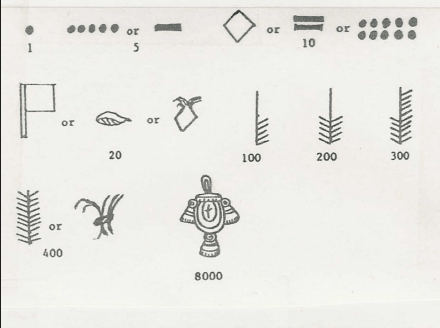
Groupings of 20 were denoted by a flag, quantities of 400 by a stylised fir tree, and groupings of 8,000 by an incense bag. Five flags would thus mean a quantity of one hundred (i.e. 5×20). Examples from a page of the Codex Mendoza can be seen below.
It all still draws me back to this though. Or maybe these little houses were for the chaneque? (1)
- What are chaneque? I’m glad you asked……Modern Adoration : The Power of Religion in Healing : Return of the Old Gods.

Nahuatl language is new to me. I have only really learned things by accident as they were involved with the herbs I was studying. The language is very interesting and I am putting more effort to learn it.
Now, you should head back to the main path. Sidetrack over.
Text References
- Berdan, Frances F., and Patricia Rieff Anawalt, eds.1992 The Codex Mendoza. 4 vols. Berkeley: University of California Press.
- Berdan, Frances F., et al. Aztec Imperial Strategies. Washington, D.C.: Dumbarton Oaks, 1996. A description of Aztec culture that relies upon textual and artifactual sources.
- Birx, H.J; (Ed.) Encyclopedia of anthropology (2006) Aztec agriculture (Vol. 5, pp. 321-322) (2006). SAGE Publications, Inc., https://doi.org/10.4135/9781412952453.n9
- Davies, Nigel. The Aztecs. Norman: University of Oklahoma Press, 1980. A general discussion of Aztec political evolution by an ethnohistorian.
- Díaz del Castillo, Bernal. The Discovery and Conquest of Mexico. Translated by A. P. Maudslay. Introduction by Hugh Thomas. New York: Da Capo Press, 1996. Written in the 1560’s and first published in 1632. Díaz del Castillo wrote his vivid memories of the conquest of Mexico and his observations of the Aztecs and of Montezuma II.
- Hassig, R. (1981). The Famine of One Rabbit: Ecological Causes and Social Consequences of a Pre-Columbian Calamity. Journal of Anthropological Research, 37(2), 172–182. http://www.jstor.org/stable/3629708
- Longhena, Maria. Ancient Mexico: The History and Culture of the Maya, Aztecs, and Other Pre-Columbian Peoples. New York: Stewart, Tabori & Chang, 1998. An examination of Aztec history and culture, alongside the cultures of the Maya, the Olmecs, and other ancient civilizations, emphasizing the importance of religion in every aspect of indigenous people’s behavior and experience.
- Martínez Ruiz, J. L. (2014). The chinampa: a sustainable high efficient agrohydrologic system for shallow lacustrine and wetland areas. Water Practice and Technology, 9(3), 324-330.
- Marx JL. Amaranth: a comeback for the food of the aztecs? Science. 1977 Oct 7;198(4312):40. doi: 10.1126/science.198.4312.40. PMID: 17741884.
- Nielsen, H. (1996). THE 2:2:1 TRIBUTE DISTRIBUTION IN THE TRIPLE ALLIANCE: Analyzing the Tetzcocan manuscripts. Ancient Mesoamerica, 7(2), 207–214. http://www.jstor.org/stable/26307167
- Sanders, W.T. 1957. Tierra y agua (soil and water): A study of the ecological factors in the development of Meso-American civilization, 2 vols. Unpublished Ph.D. dissertation. Cambridge: Harvard University.
- Smith, Michael E. The Aztecs. 2d ed. Malden, Mass.: Blackwell, 2003. A wellillustrated discussion of the evolution of the Aztec state, based primarily on archaeological research of the late twentieth century.
- Townsend, Richard F. The Aztecs. Rev. ed. New York: Thames and Hudson, 2000. Anoverview of Aztec culture, incorporating illustrations of Aztec art and their environment.
Glyph References
- Calli – Glyph 1 : https://aztecglyphs.wired-humanities.org/content/calli-mdz10r : Codex Mendoza, folio 10 recto
- Calli – Glyph 2 : https://aztecglyphs.wired-humanities.org/content/calli-cq : Codex Quetzalecatzin, aka Mapa de Ecatepec-Huitziltepec
- Calli – Glyph 3 : https://aztecglyphs.wired-humanities.org/content/calli-t17352109 : Single-page codex, Archivo General de la Nación, México, Ramo de Tierras, vol. 1735, exp. 2, fol. 109
- Cal(li), house/building, also day sign : https://aztecglyphs.wired-humanities.org/content/calli-tr15r
- The Codex Quetzalecatzin : https://www.loc.gov/resource/g4701g.ct009133/?r=-0.005,1.101,0.215,0.128,0
- Compound glyph for the place name Tepeyacac : https://aztecglyphs.wired-humanities.org/content/tepeyacac-mdz10v : Codex Mendoza, folio 10 verso
- Compound glyph for the place name Tlayacapan : https://aztecglyphs.wired-humanities.org/content/tlayacapan-mdz24v : Codex Mendoza, folio 24 verso
- Cuezcoma(tl), maize storage container, https://nahuatl.wired-humanities.org/content/cuezcomatl : Codex Mendoza, folio 10 verso
- Huexotzinco Codex, 1531 : Plate 7, tributes : https://mapas.wired-humanities.org/huexotzinco/elements/huexotzincoplate7/000
- Jocotepec : https://aztecglyphs.wired-humanities.org/content/xocotl-mdz8r
- Pantli 1 : (panitl) https://aztecglyphs.wired-humanities.org/content/panitl-mdz24v : Codex Mendoza, folio 24 verso
- Pantli 2 : https://aztecglyphs.wired-humanities.org/content/pantli-mh616r : Matrícula de Huexotzinco, folio 616r
- Pantli 3 : https://aztecglyphs.wired-humanities.org/content/pantli-mh667r : Matrícula de Huexotzinco, folio 667r
- Tecpancal(li), royal palace : https://aztecglyphs.wired-humanities.org/content/tecpan-hj27679pt3233r
- Yaca(tl), nose, peak, or the point of something : https://aztecglyphs.wired-humanities.org/content/yacatl-mdz42r : Codex Mendoza, folio 42 recto
Images
- Aztec numbers : https://planetarchaeology.co.uk/maya-number-system/
- Cuexcomate : https://piedeplano.com/2025/09/07/cuexcomate/
- El Cuexcomate : Morelos Route : https://www.facebook.com/photo/?fbid=792064802928948&set=a.487675650034533
- Extent of the Lands shown in the Codex Quetzalecatzin. Map created by John Hessler, Geography and Map Division.: https://blogs.loc.gov/maps/2017/11/the-codex-quetzelecatzin/

